
Why Middle East Car Demand Is Surging and How to Capitalize on the 126 Billion Dollar Opportunity
Introduction
The Middle East used car market is experiencing significant growth in February 2026. The market is valued at 97.87 billion dollars this year and is projected to reach 126.34 billion dollars by 2031 at a compound annual growth rate of 5.23 percent.
Saudi Arabia holds 34.20 percent of the regional market share, while the UAE records the fastest growth rate at 6.82 percent CAGR. Growth is driven by digital marketplaces, free zone logistics, and progressive consumer protection regulations that strengthen cross border trade confidence.
This is not temporary demand. It reflects structural transformation fueled by Vision 2030 economic diversification, rising disposable incomes, expanding highway infrastructure, and simplified customs procedures that shorten import cycles and widen vehicle availability.
For U.S. auto dealers, auction buyers, and vehicle exporters, February 2026 represents a critical window. Sailings are closing quickly as Middle East importers secure inventory ahead of Ramadan. Many exporters still rely on general freight brokers that lack regional expertise, bilingual communication, and multi warehouse infrastructure required for Middle East automobile logistics. Success in this market requires a specialized Middle East freight partner.
The Middle East Auto Market: Three Growth Drivers
1. Market Expansion Across Gulf States
The UAE used car market generated AED 112 billion in revenue in 2025, growing at 16.6 percent CAGR and establishing Dubai as a dominant regional trade hub.
Saudi Arabia benefits from high disposable income levels, extensive highway networks, and Vision 2030 initiatives that accelerate commercial fleet turnover. Iraq, Jordan, and neighboring markets show similar expansion trends driven by urbanization and growing middle class populations.
American vehicles hold strong appeal in the region. Pickups, SUVs, performance cars, and luxury vehicles are in high demand. SUVs capture substantial market share due to terrain and family transportation needs. U.S. auction platforms such as Copart, IAAI, and Manheim provide inventory aligned with these preferences at price levels that support profitable export margins.
2. Digital Transformation Accelerates Cross Border Trade
Organized used car channels in the Middle East are growing at 6.55 percent CAGR, faster than the overall market. Certified programs and digital marketplaces are replacing informal dealer networks.
The UAE leads digital innovation, including blockchain based vehicle history documentation. Free zone logistics infrastructure enables efficient re export into African markets, while improved consumer protection rules increase confidence in international online purchases.
This digital environment benefits U.S. exporters. Middle East buyers increasingly source vehicles directly from U.S. auctions, relying on freight forwarders to manage pickup, documentation, ocean shipping, and delivery. The challenge is not finding buyers. The challenge is executing logistics with compliance accuracy, transparent pricing, and responsive communication.
3. February 2026 Timing Before Ramadan
Timing is critical in Middle East automobile logistics. February sailings close rapidly as importers prepare for Ramadan. During Ramadan, working hours shorten, warehouse activity slows, and delivery timelines extend.
Vehicles arriving during Ramadan risk prolonged port storage and delayed customs clearance. Pre Ramadan demand concentrates vessel bookings, pushing spot rates up by 20 to 30 percent and causing container shortages that delay loading at major ports.
Shipping lines prioritize customers with established relationships and consistent volume. February 2026 is therefore the window to secure capacity at competitive rates before peak pricing impacts margins.
Why Middle East Automobile Logistics Requires Specialization
Shipping vehicles to the Middle East involves complexities beyond simple ocean bookings.
Documentation accuracy is essential. Each destination has distinct import requirements.
- Dubai and Jebel Ali require original title, bill of sale, and importer identification. Transit times range between 21 and 35 days.
- Jordan through Aqaba requires title, bill of sale, and importer license with duty and VAT estimates supporting buyer quotes.
- Iraq through Basra or Umm Qasr requires title, commercial invoice, and consignee identification with detailed compliance procedures. Transit times range between 28 and 45 days.
Destination specific knowledge prevents customs holds, duty reassessments, and buyer disputes.
Bilingual communication is equally important. Buyers expect Arabic and English support with real time updates across time zones that differ by seven to eleven hours from U.S. operations.
Warehouse infrastructure directly affects cost and speed. Efficient export requires consolidation points near major U.S. ports serving Gulf routes. Warehouses in New York, Savannah, Houston, California, and Greensboro support inspection, documentation processing, and coordinated loading.
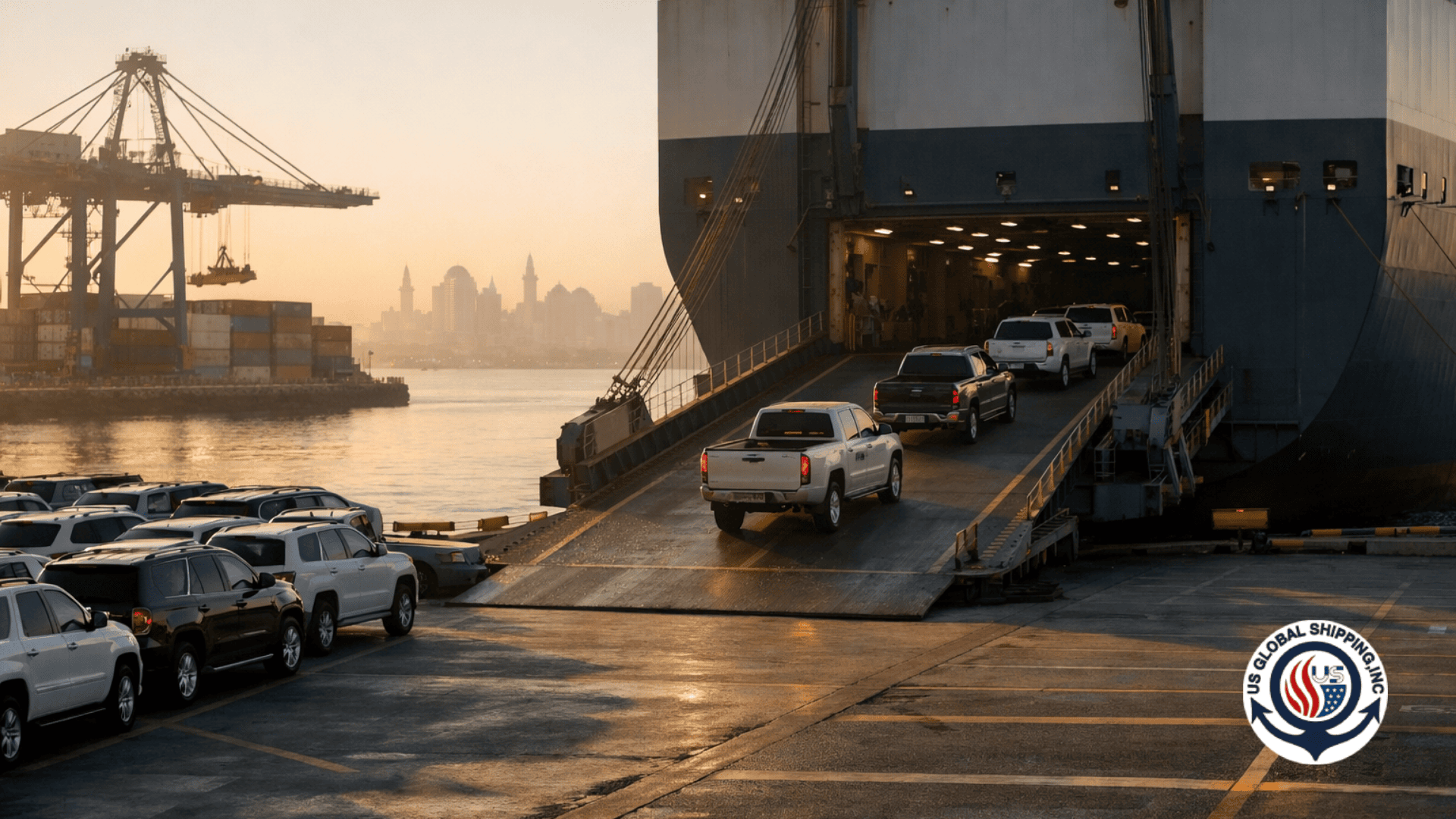
Mode flexibility maximizes value. RORO transport provides cost efficiency for operational vehicles. Container services offer weather protection for higher value or non running vehicles and allow consolidation with household goods.
How US Global Shipping Supports Middle East Automobile Exporters
US Global Shipping has developed capabilities specifically for Middle East automobile trade.
Headquartered in Greensboro, North Carolina, with warehouses in New York, Savannah, Houston, and California, US Global combines trade lane expertise with nationwide infrastructure.
Strategic Warehouse Network
US Global provides:
- Vehicle receiving and processing at Houston and California for Gulf and West Coast departures
- East Coast consolidation through New York and Savannah for faster transit to Jordan and Red Sea markets
- Centralized coordination and documentation management in Greensboro
- Secure storage during auction payment settlement and vessel booking confirmation
This structure reduces inland transport costs and accelerates movement from auction pickup to vessel loading.
Comprehensive Services from Auction to Delivery
US Global offers:
- Nationwide auction pickup from Copart, IAAI, Manheim, and other platforms
- Title and documentation management including export paperwork and destination specific certificates
- RORO shipping for operational vehicles with established carrier relationships
- Professional container loading for non running or high value vehicles
- Real time shipment tracking through a dedicated mobile application
- Arabic and English speaking customer support available around the clock
Destination Expertise Across Major Markets
US Global manages destination requirements across:
- UAE with streamlined customs and predictable transit times
- Saudi Arabia with high volume passenger and commercial demand
- Kuwait with inspection and registration protocols
- Iraq with detailed compliance procedures
- Jordan with structured duty and VAT calculations
Regional knowledge ensures smooth customs clearance and protects buyer relationships.
Practical Strategies for Exporters
- Secure February sailings early to avoid Ramadan delays and premium pricing.
- Focus on SUVs, pickups, luxury vehicles, and commercial trucks that align with Middle East demand patterns.
- Partner with specialized Middle East freight forwarders rather than general brokers.
- Provide transparent documentation and vehicle histories to align with formalized market growth trends.
Capture Middle East Automobile Demand
February 2026 presents a significant opportunity in Middle East automobile export. Pre-Ramadan demand, tightening vessel capacity, and sustained regional growth create favorable conditions for exporters positioned with the right logistics partner.
US Global Shipping provides U.S. warehouse infrastructure, RORO and container services, destination specific documentation expertise, bilingual support, and real time tracking.
Whether exporting volume inventory or entering the Middle East market for the first time, US Global delivers the operational capability required to convert demand into sustainable growth.
Contact US Global Shipping to secure February sailing capacity and build long term Middle East export success.