How to Ship a Car from USA to Cameroon: Container Shipping, Douala Port, and What to Know in 2026
How to Ship a Car from USA to Cameroon: Container Shipping, Douala Port, and What to Know in 2026
Shipping a car from the USA to Cameroon in 2026 requires four things: the right shipping method (container for most auction and non-running vehicles, RoRo for drivable cars), mandatory AES/EEI export filing with the US Census Bureau, a BESC/ECTN certificate validated at least 48 hours before the vessel reaches Douala, and an SGS pre-shipment inspection. Only left-hand drive vehicles are permitted. US Global Shipping handles every step from US auction pickup to Bill of Lading issuance for Cameroon-bound shipments.
Cameroon: One of West Africa's Most Active US Vehicle Import Markets
Cameroon is known as Africa in miniature for good reason. The country sits at the crossroads of West and Central Africa, serves as a re-export hub for landlocked nations including Chad and the Central African Republic, and runs one of the continent's busiest vehicle import corridors. The Port of Douala processes the majority of Cameroon's maritime trade, and vehicles from the USA represent a consistent and significant portion of that incoming freight.
For Cameroonian importers, the economics of sourcing vehicles from the US are compelling. Late-model Toyota Camrys, Honda Accords, Hyundai Tucsons, and SUVs purchased at American insurance auctions can be repaired and resold at a significant margin relative to locally available alternatives. The Cameroonian market's appetite for these vehicles is steady, and the diaspora community across the US East Coast sends vehicles home regularly.
The process is entirely manageable when approached in the correct sequence. Where importers run into serious problems is not in the shipping itself, but in the documentation, particularly the BESC/ECTN certificate and the SGS pre-shipment inspection, both of which are Cameroon-specific requirements that differ from the documentation chain used for Nigeria, Ghana, or other West African destinations.
US Global Shipping has been serving vehicle exporters and diaspora shippers on the West Africa corridor since 2014. Our auto export service covers the complete process from inland transportation from the auction yard to Bill of Lading issuance, including all mandatory US and Cameroon-side documentation.
Step 1: Confirm Vehicle Eligibility Before You Buy
Cameroon has several firm requirements that determine whether a vehicle can legally be imported. These must be confirmed before placing a bid at Copart, IAAI, Manheim, or any other US auction.
Left-Hand Drive Only
Cameroon banned the importation of right-hand drive vehicles in late 2008, and the ban remains strictly enforced. All vehicles entering Douala Port must be left-hand drive. Vehicles sourced from the USA are almost universally left-hand drive, so this restriction rarely creates a problem for buyers purchasing from American auctions. If you are sourcing from Canada or Japan alongside your US purchases, verify the drive configuration before committing.
Vehicle Age and the Duty Structure
Cameroon does not impose a blanket age ban equivalent to Nigeria's 15-year rule. However, the duty structure is graduated based on vehicle age. Under the current CEMAC Common External Tariff framework, vehicles under 15 years old are assessed at approximately 91 percent of their appraised CIF value for customs duty purposes. Vehicles over 15 years old face a steeper rate of approximately 107 percent. This means older vehicles are not prohibited, but the customs cost increases substantially for vehicles manufactured before 2011 when calculated on a 2026 import. Plan your budget with this in mind before bidding on older auction stock.
What CIF Means for Duty Calculation
CIF stands for Cost, Insurance, and Freight. Cameroon Customs calculates duty on the combined value of: the vehicle purchase price, the marine insurance cost, and the ocean freight to Douala. The duty is applied to this combined figure, not just the auction purchase price. Work with your clearing agent in Douala to understand your full landed cost before bidding.
SGS Pre-Shipment Inspection (PSI)
All imports into Cameroon valued at CFAF 2 million (approximately USD 3,300) or above must be inspected by Societe Generale de Surveillance (SGS) before shipment. For vehicles, this inspection is conducted at the US port of export and covers safety systems, emissions components, and overall vehicle conformity with Cameroon's standards. The inspection generates an Attestation de Verification a l Importation (AVI) certificate, which is required at Douala customs. SGS inspection must be coordinated before loading, which is one reason working with an experienced freight forwarder on this route matters. US Global Shipping coordinates SGS inspection scheduling as part of our standard export process for Cameroon-bound vehicles.
Salvage Vehicles: What Is and Is Not Accepted
Cameroon does not have a blanket prohibition on salvage-titled vehicles equivalent to Saudi Arabia's restrictions. However, vehicles must have a valid original US title. Flood-damaged and accident vehicles that are in a repairable condition are routinely imported into Cameroon. Vehicles without titles, or with disputed ownership documentation, will face significant problems at Douala customs.
Step 2: Container Shipping vs RoRo for Cameroon
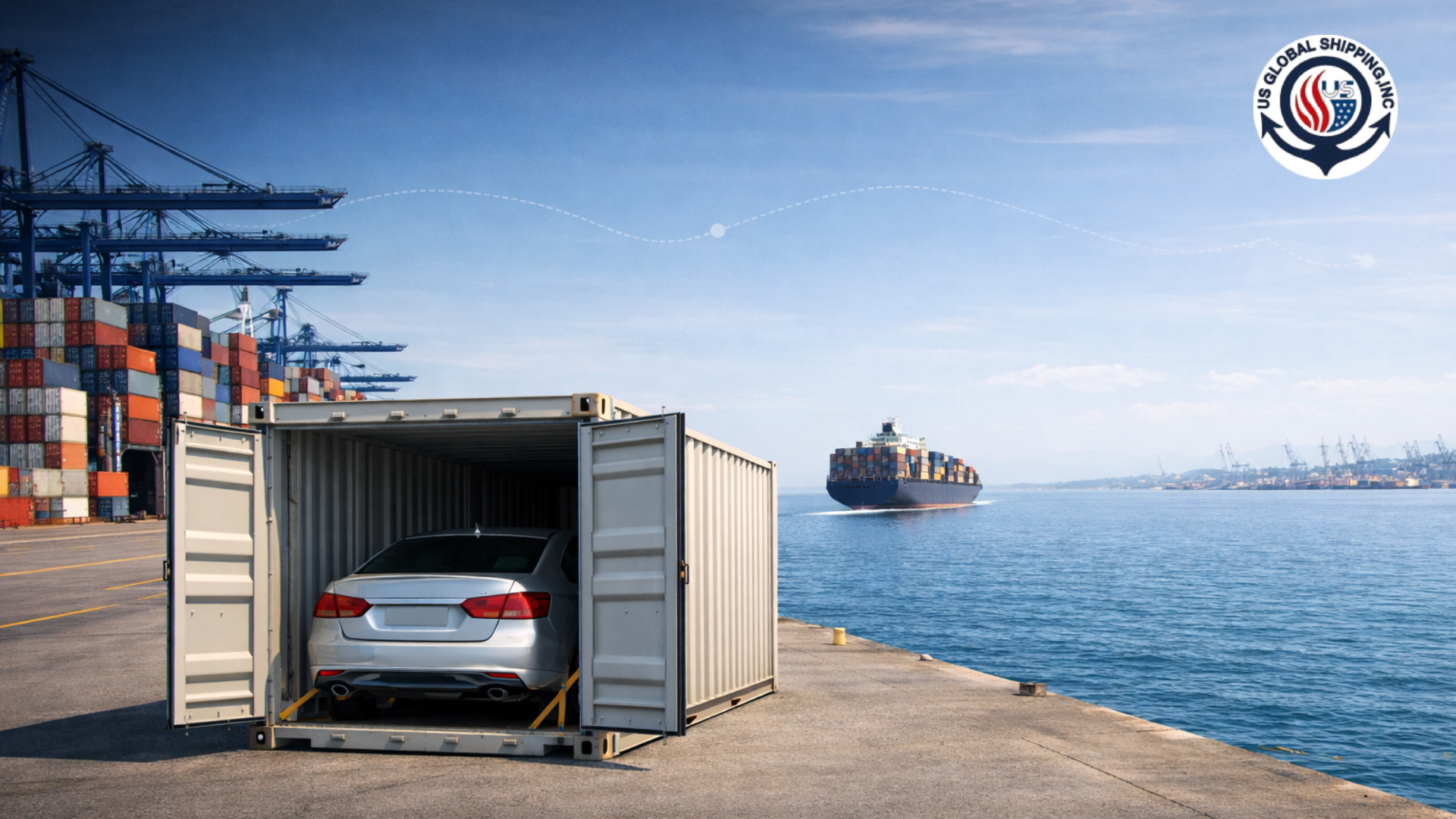
Two methods are available for shipping vehicles from the USA to Cameroon: container shipping and RoRo (Roll-on/Roll-off). The choice affects cost, timeline, vehicle protection, and what condition the car needs to be in at the point of loading.
| Factor | Container Shipping | RoRo Shipping |
|---|---|---|
| Vehicle condition required | Running or non-running | Must start, steer, and brake |
| Salvage or flood vehicles accepted | Yes, all conditions | No, operational only |
| Vehicle protection | Fully enclosed steel container | Exposed on vessel deck |
| Spare parts allowed | Yes, within the container | No personal items permitted |
| Typical transit from Baltimore | 18 to 25 days | 18 to 22 days |
| Best suited for | Auction cars, non-runners, multiple vehicles | Clean-title drivable vehicles |
Container shipping is the dominant method for the US-to-Cameroon vehicle corridor, particularly for buyers sourcing from Copart and IAAI where non-running and salvage inventory is common. A standard 20-foot container holds one to two vehicles. A 40-foot container can accommodate three to four, and consolidation options allow single-vehicle buyers to share container space and reduce per-vehicle freight cost. If you are shipping multiple vehicles regularly or want to include spare parts and accessories in the same shipment, container shipping is the practical choice.
RoRo is best suited for operational, clean-title vehicles where cost efficiency on a single drivable car is the priority. US Global Shipping offers both container and RoRo options from East Coast ports. For questions about which method best fits your vehicle and timeline, the free consultation page is the quickest way to get a specific answer for your shipment.
Step 3: US Export Ports and Transit Times to Douala
East Coast ports offer the shortest transit times and lowest inland transport costs for vehicles originating from Copart, IAAI, and Manheim yards across the Southeast and Mid-Atlantic US. This is a practical advantage for buyers whose auction inventory is concentrated in North Carolina, South Carolina, Georgia, Virginia, and Florida.
| US Export Port | Estimated Transit to Douala | Notes |
|---|---|---|
| Baltimore, MD | 18 to 20 days | Fastest route. ACL Grimaldi direct service to Douala. |
| Jacksonville, FL | 20 to 22 days | Sallaum Line service. Efficient for South Florida yards. |
| Savannah, GA | 22 to 25 days | Best for SE US auction yards including NC, SC, GA. |
| New York/New Jersey | 22 to 25 days | Good option for Northeast diaspora community shipments. |
| Houston, TX | 25 to 28 days | Longer transit. Best for Gulf Coast and Texas sourcing. |
US Global Shipping is based in Greensboro, NC, which places us within one to three days inland transit of most Copart and IAAI yards in the Southeast US. Most vehicles can reach Baltimore or Savannah faster from our network than from a West Coast-based forwarder serving the same origin yards. For an overview of how we coordinate vehicle pickup and port delivery, see our inland transportation service page.
Step 4: US Export Documentation (AES/EEI Filing)
The US export documentation process is identical for Cameroon as it is for every other international vehicle export destination. The Automated Export System (AES) Electronic Export Information (EEI) filing is mandatory for all used self-propelled vehicles regardless of value or destination country. This is established by US Census Bureau Foreign Trade Regulations Section 30.2.
What AES/EEI Requires
- Original vehicle title released by the auction after full payment
- Vehicle identification number (VIN) and Schedule B classification code
- Declared CIF value of the vehicle
- Shipper (USPPI) information with a valid US EIN or DUNS number
- Consignee information for the Cameroonian importer
- Destination country declared as Cameroon
Once the AES filing is accepted, the system generates an Internal Transaction Number (ITN) formatted as AES X20260XXXXXXXXX. This ITN must appear on the Master Bill of Lading. Without a confirmed ITN, the ocean carrier cannot legally load the vehicle onto the vessel, and US Customs and Border Protection may detain the shipment. Civil penalties for non-compliance begin at $1,100 per violation per day under current FTR enforcement guidelines.
International buyers cannot file AES/EEI themselves. The filer must be a US-domiciled entity with a valid EIN, which means an FMC-licensed NVOCC or authorized US freight forwarder must handle this step on your behalf. US Global Shipping files AES/EEI for every Cameroon-bound shipment as part of our standard service.
Step 5: The BESC/ECTN Certificate (Cameroon-Specific Requirement)
This is the document that catches first-time Cameroon shippers off guard because it has no equivalent in most other markets. The BESC, which stands for Bordereau Electronique de Suivi des Cargaisons, is the French-language term for the Electronic Cargo Tracking Note (ECTN) used in Cameroon. It is a mandatory cargo tracking certificate required for every ocean freight shipment entering Cameroon, enforced by the Ministry of Transport Cameroon and administered by the Cameroon National Shippers Council (CNSC).
What the BESC/ECTN Covers
- Complete shipper and consignee information
- Vessel name, voyage number, loading and discharge ports
- Container or RoRo shipment type and reference number
- Full cargo description and declared value
- Freight invoice details
- Import declaration reference number from the Cameroonian importer
When It Must Be Validated
The BESC/ECTN certificate must be validated at least 48 hours before the vessel arrives at Douala Port. This is a hard deadline. Missing it results in fines imposed by Cameroonian customs at the port of discharge, which can delay clearance or result in the shipment being held until the issue is resolved.
The safest practice is to begin the BESC application as soon as a draft Bill of Lading is available from the ocean carrier, typically three to five days after the vessel departs the US port. A draft copy is sufficient to start the process. Early submission avoids last-minute corrections that add cost and delay.
Documents Needed to Obtain the BESC
- Draft or original Bill of Lading
- Commercial invoice showing the declared vehicle value
- Freight invoice if freight charges are not on the commercial invoice
- Import Declaration (Declaration d Importation) with Transaction ID and Tax Payer number from the Cameroonian consignee
- For RoRo shipments effective from May 2025: proof of FIMEX registration or a valid Special Import Authorization
Document Consistency Is Critical
The BESC is rejected or delayed when there are discrepancies between the commercial invoice, packing list, Bill of Lading, and freight invoice. Declared values, cargo descriptions, and container or vehicle references must match exactly across all documents. Even a minor mismatch in weight or value triggers a correction request, which takes additional time and fees to resolve.
Step 6: What Happens at the Port of Douala
The Port of Douala is located on the Wouri River and is Cameroon's primary international maritime gateway. It handles the majority of the country's vehicle imports and serves as a transit hub for goods moving onward to Chad and the Central African Republic. The port operates under a Single Window system called GUCE (Guichet Unique du Commerce Exterieur), which consolidates customs, banking, port authority, and inspection services into one administrative process.
When your vehicle arrives at Douala, your appointed Cameroonian clearing agent will need the following documents to initiate customs clearance:
- Original Bill of Lading (or Telex/Express Release)
- Validated BESC/ECTN certificate
- SGS AVI certificate from the pre-shipment inspection
- Commercial invoice
- Import Declaration with Transaction ID
- Proof of insurance
Customs clearance at Douala Port typically takes seven to ten business days when all documentation is complete. Incomplete or mismatched documents extend this significantly, and demurrage charges at Douala accumulate daily for cargo that is not cleared promptly. Appointing an experienced local clearing agent before the vessel departs the USA is not optional. It is a practical necessity for avoiding port storage fees.
One important point for Francophone buyers or those working with French-speaking clearing agents: Cameroon is a bilingual country, and customs documentation at GUCE is primarily processed in French. Having a shipping partner who can communicate in both English and French, or who has established relationships with bilingual local agents, significantly reduces the risk of documentation errors during port processing.
Cameroon Vehicle Import Regulations Summary 2026
| Regulation | Rule in 2026 |
|---|---|
| Drive configuration | Left-hand drive only. RHD vehicles banned since late 2008. |
| Vehicle age (duty impact) | Under 15 years: approx. 91% of assessed CIF. Over 15 years: approx. 107% of assessed CIF. |
| BESC/ECTN certificate | Mandatory for all shipments. Must be validated 48+ hours before vessel arrival at Douala. |
| SGS pre-shipment inspection | Required for imports valued at CFAF 2 million (approx. USD 3,300) or above. |
| RoRo additional requirement | Since May 1, 2025: FIMEX registration proof or Special Import Authorization required. |
| Customs authority | Cameroon DGD (Direction Generale des Douanes) under CEMAC Common External Tariff. |
| VAT on imports | Approximately 19.25% applied on CIF value plus customs duty. |
| Prohibited vehicle types | Right-hand drive vehicles. Vehicles without valid original titles. |
Frequently Asked Questions: Shipping Cars from USA to Cameroon
Can I ship a car from the USA to Cameroon?
Yes. Vehicles can be shipped from the USA to Cameroon by container or RoRo to the Port of Douala. Container shipping is suitable for all vehicle conditions including non-running and salvage cars. RoRo requires the vehicle to be drivable. Both methods require AES/EEI export filing in the USA and a BESC/ECTN certificate before arrival at Douala. US Global Shipping provides full-service vehicle export to Cameroon from East Coast US ports.
What is the BESC/ECTN certificate and why is it required?
The BESC (Bordereau Electronique de Suivi des Cargaisons) is a mandatory cargo tracking certificate required for all ocean freight entering Cameroon. It must be validated by the Cameroon National Shippers Council at least 48 hours before the vessel arrives at Douala. Shipments without a valid BESC face fines, clearance delays, or cargo refusal at the port. The certificate is prepared by an authorized agent and must reflect all shipping documents precisely.
What documents are needed to ship a car from USA to Cameroon?
You need: original US vehicle title, AES/EEI ITN confirmation, commercial invoice, Bill of Lading, packing list, BESC/ECTN certificate, and an SGS pre-shipment inspection AVI certificate for vehicles valued at CFAF 2 million or above. US Global Shipping handles all US-side export documentation as part of our FMC-licensed NVOCC service.
How long does shipping take from USA to Cameroon?
Ocean transit from East Coast US ports to Douala ranges from 18 days (Baltimore) to 28 days (Houston). Add five to fifteen business days from auction purchase for title release and inland transport to the export port. Total time from auction purchase to Douala arrival is typically 25 to 45 days depending on origin port and carrier schedule.
Are right-hand drive cars allowed in Cameroon?
No. Cameroon has prohibited right-hand drive vehicle imports since late 2008. All vehicles entering Cameroon must be left-hand drive. US-sourced vehicles from Copart, IAAI, Manheim, and other American auctions are almost all left-hand drive and therefore compliant with this requirement.
What is the SGS pre-shipment inspection?
Cameroon requires a pre-shipment inspection by Societe Generale de Surveillance (SGS) for all imports valued at CFAF 2 million or above. For vehicles, SGS conducts a safety and emissions inspection at the US export port and issues an Attestation de Verification a l Importation (AVI) certificate. This certificate is required at Douala customs. US Global Shipping coordinates SGS scheduling before loading.
Can I ship a non-running or salvage car to Cameroon?
Yes. Non-running and salvage-titled vehicles can be shipped to Cameroon via container. The vehicle is loaded by forklift or winch at the US export port and enclosed in a steel container for the ocean voyage. A valid US title (salvage or clean) is required. There is no blanket prohibition on salvage vehicles in Cameroon, but vehicles must meet documentation requirements at Douala customs.
Which US port is best for shipping to Cameroon?
Baltimore, MD offers the fastest transit time to Douala at approximately 18 to 20 days via ACL Grimaldi direct service. Jacksonville, FL is a strong second at 20 to 22 days. Both ports are close to Copart and IAAI yards across the Southeast US. US Global Shipping uses East Coast ports for all Cameroon shipments from our Greensboro, NC base.
Why Work with US Global Shipping for Cameroon Exports
Shipping a vehicle to Cameroon involves more country-specific documentation steps than most other West African destinations. The BESC/ECTN certificate, the SGS pre-shipment inspection, the GUCE single-window process at Douala, and the AES/EEI filing in the USA all need to happen in the right sequence and with completely consistent information across every document. When any one of those documents is missing, late, or inconsistent with another, the vehicle sits at Douala Port and generates charges.
US Global Shipping manages this process from end to end. We are an FMC-licensed Non-Vessel Operating Common Carrier (NVOCC) based in Greensboro, NC, and we have been handling West Africa vehicle exports since 2014. Here is what that means for Cameroon-bound shipments specifically:
- AES/EEI filing is included in our service: We file your Electronic Export Information with the US Census Bureau, generate your ITN, and transmit it to the carrier before loading. No vehicle leaves the US port without a confirmed ITN.
- SGS inspection coordination: We coordinate the SGS pre-shipment inspection scheduling at the US export port so it is completed before your loading window. The AVI certificate travels with your shipping documents.
- BESC/ECTN advisory: We advise every Cameroon-bound client on the BESC requirements, the 48-hour validation deadline, and the document consistency rules that cause most delays. We flag any discrepancy in your documents before they reach the authorization stage.
- East Coast port advantage: Our Greensboro, NC location gives us the shortest inland transit routes to Baltimore, Savannah, and Jacksonville from the majority of Southeast US auction yards. The vehicles reach the port faster and at lower inland cost.
- Full ocean freight service: From container booking to Bill of Lading issuance, our ocean freight service covers weekly sailings from East Coast US ports to Douala using carriers with established Cameroon schedules.
If you are shipping a car from a US auction to Cameroon for the first time, or if you are a regular importer looking for a reliable East Coast forwarder for this route, our team is ready to assist. Cameroon's documentation requirements are specific, but they are predictable when managed correctly from the start.
You can also read our guide to exporting auction cars from the USA to Nigeria and Ghana for a comparison of West Africa export routes and documentation requirements. The processes share several common elements, but the Cameroon-specific requirements covered in this post are distinct from what Nigeria and Ghana require.
Contact US Global Shipping for Cameroon Shipments
Phone: 1-800-373-3244
Email: [email protected]
Address: 528-B College Rd, Greensboro, NC 27410
Website: www.us-globalshipping.com
Free Consultation: us-globalshipping.com/free-consultation
Auto Export Service: us-globalshipping.com/auto-export
Ocean Freight: us-globalshipping.com/ocean-freight
Inland Transportation: us-globalshipping.com/inland-transportation