
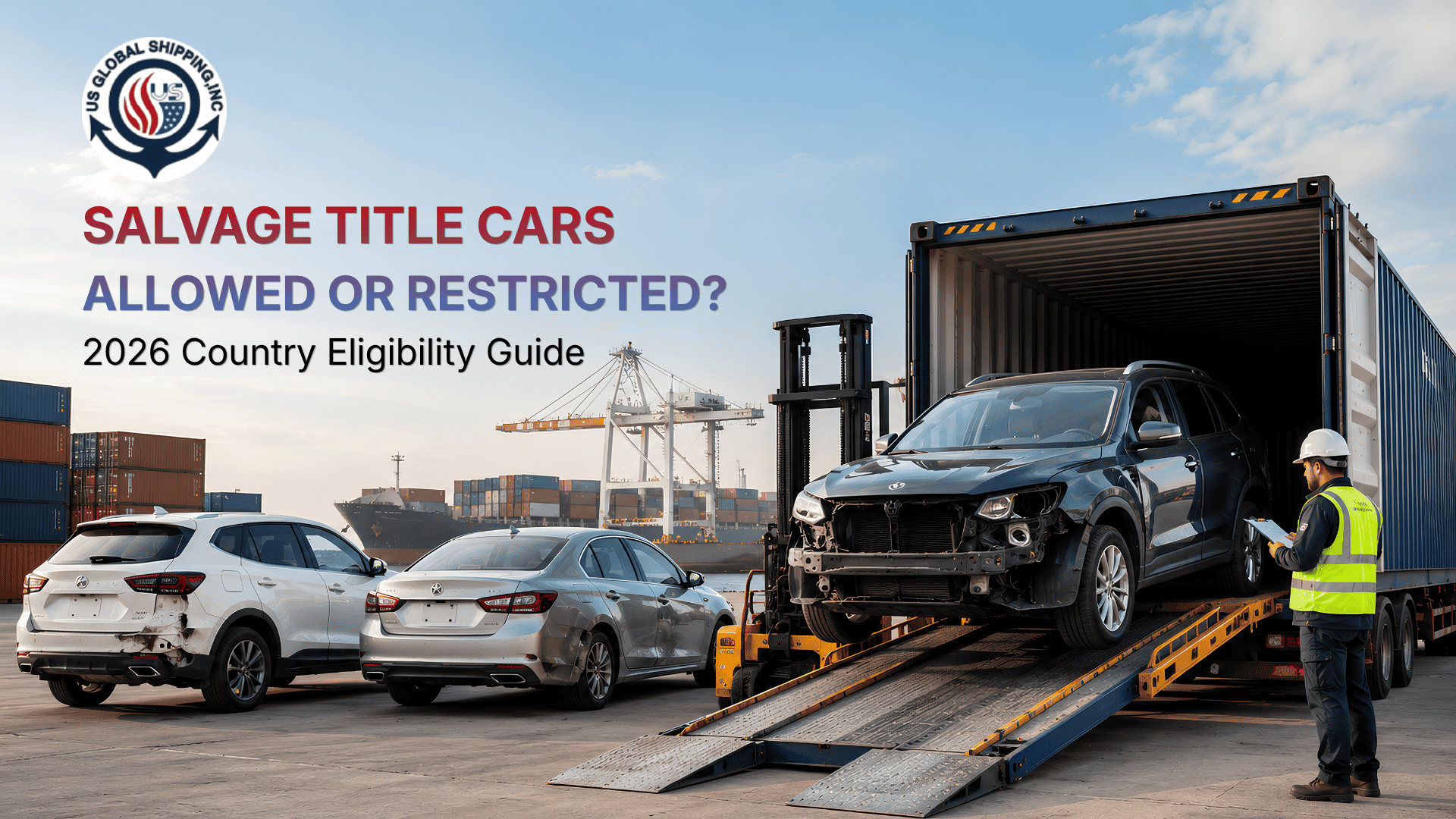
Salvage Title Cars from US Auctions: Which Countries Allow Imports in 2026 (Complete Eligibility Map)
Salvage Title Cars from US Auctions: Which Countries Allow Imports in 2026 (Complete Eligibility Map)
As of 2026, salvage title cars from US auctions can be legally imported into more than 30 countries, including Nigeria, the UAE, Jordan, Poland, Lithuania, Ukraine, Georgia, Honduras, Guatemala, and Mexico. Countries that ban or heavily restrict salvage imports include Ghana, El Salvador, Saudi Arabia, Kenya, the Philippines, and most of Western Europe. Always verify the destination country's current rules before bidding.
Salvage title cars from US auctions are legally importable in 30+ countries. Ghana banned all salvage imports in 2020. El Salvador prohibits salvage and rebuilt titles. The UAE, Jordan, Poland, Lithuania, and Ukraine operate active rebuild markets. Most African countries enforce 8–10 year vehicle age limits. EU countries permit salvage imports but require destination-country safety re-certification (TUV in Germany, IVA in the UK, RDW in the Netherlands).
Salvage Import Rules by Region (2026)
West Africa: Nigeria, Benin, Togo, Burkina Faso allow salvage freely. Ghana bans all salvage imports.
East Africa: Kenya, Tanzania, Uganda are right-hand-drive only — most US salvage cars do not qualify.
Eastern Europe / Caucasus: Poland, Lithuania, Latvia, Ukraine, Georgia, Armenia allow salvage. Strong rebuild market.
Western Europe: Germany, UK, Netherlands allow salvage but require expensive safety re-certification.
Middle East: UAE, Jordan, Iraq, Lebanon allow salvage. Saudi Arabia and Kuwait have strict GCC standards.
Central America: Honduras, Guatemala, Nicaragua allow salvage. El Salvador and Costa Rica do not.
Caribbean: Dominican Republic permits with restrictions. Jamaica and Trinidad are RHD-only.
Asia: Mongolia and Kazakhstan allow salvage. Philippines and Pakistan generally ban used-car imports.
Complete Salvage Import Eligibility Map: 40+ Countries (2026)
The table below maps salvage title car import eligibility for every major destination served by US auction exporters. The four-tier classification system makes the data scannable for buyers and extractable for search engines and AI answer engines.
Tier classification key
- Tier 1 — Open: Salvage and rebuilt titles broadly accepted; active rebuild markets and routine clearance.
- Tier 2 — Restricted: Salvage permitted but conditional on age limits, inspections, or specific paperwork.
- Tier 3 — Heavily Restricted: Salvage technically allowed but practical barriers (re-certification cost, RHD-only, strict emissions) make imports rare.
- Tier 4 — Banned: Salvage and rebuilt title vehicles prohibited by law; clean titles only.
| Country | Tier (2026) | Age Limit | Salvage Title | Key Requirement |
|---|---|---|---|---|
| Nigeria | Tier 1 — Open | 10 yrs max | Allowed | SONCAP cert, Form M, PAAR, Bill of Lading; container preferred |
| Benin | Tier 1 — Open | No strict limit | Allowed | Major transshipment hub for Nigerian-bound salvage cars |
| Togo | Tier 1 — Open | No strict limit | Allowed | Lome port accepts salvage; rebuild market active |
| Senegal | Tier 2 — Restricted | 8 yrs max | Allowed with conditions | Dakar port; pre-shipment inspection required |
| Côte d'Ivoire | Tier 2 — Restricted | 5 yrs (most), 7 yrs (some) | Allowed with conditions | Age limit strictly enforced; inspection mandatory |
| Ghana | Tier 4 — Banned | 10 yrs max | Banned (since 2020) | All salvage-titled vehicles prohibited; clean titles only |
| Burkina Faso | Tier 1 — Open | No strict limit | Allowed | Landlocked; routes through Togo or Côte d'Ivoire |
| Kenya | Tier 3 — Heavily Restricted | 8 yrs max | Banned (most categories) | Right-hand drive only; KEBS inspection; LHD prohibited |
| Tanzania | Tier 3 — Heavily Restricted | 10 yrs max | Restricted | Right-hand drive only; LHD US vehicles generally barred |
| Uganda | Tier 3 — Heavily Restricted | 15 yrs max | Restricted | RHD only; pre-export inspection certificate required |
| Poland | Tier 1 — Open | No age limit | Allowed (must re-register) | Major EU rebuild hub; Gdynia/Gdansk ports; VAT applies |
| Lithuania | Tier 1 — Open | No age limit | Allowed (must re-register) | Klaipeda port; large salvage rebuild industry |
| Latvia | Tier 1 — Open | No age limit | Allowed (must re-register) | Riga port; EU re-registration via TUV-equivalent |
| Estonia | Tier 2 — Restricted | No age limit | Allowed with conditions | Stricter EU re-registration; lower volume |
| Ukraine | Tier 1 — Open | No age limit | Allowed | Active rebuild market; cleared through Odesa/Constanta |
| Romania | Tier 2 — Restricted | No age limit | Allowed with conditions | EU re-registration required; Constanta port |
| Bulgaria | Tier 2 — Restricted | No age limit | Allowed with conditions | EU rules apply; Varna and Burgas ports |
| Georgia | Tier 1 — Open | No age limit | Allowed | Poti port; major regional re-export hub |
| Armenia | Tier 1 — Open | No age limit | Allowed | Imports cleared via Georgia (Poti); active rebuild market |
| Azerbaijan | Tier 2 — Restricted | Varies | Allowed with conditions | Stricter emissions; technical inspection required |
| Germany | Tier 3 — Heavily Restricted | No age limit | Restricted (TUV required) | Salvage must pass full TUV inspection; high cost barrier |
| United Kingdom | Tier 3 — Heavily Restricted | No age limit | Restricted | MOT + IVA test required; LHD permitted but costly |
| Netherlands | Tier 3 — Heavily Restricted | No age limit | Restricted | RDW inspection; difficult to clear US salvage |
| UAE | Tier 1 — Open | No strict limit | Allowed | Jebel Ali port; major rebuild + re-export hub |
| Jordan | Tier 1 — Open | 5 yrs (sedan), 10 yrs (truck) | Allowed | Aqaba port; long-established US salvage corridor |
| Saudi Arabia | Tier 2 — Restricted | 5 yrs max | Restricted | SASO certification required; strict age enforcement |
| Iraq | Tier 1 — Open | No strict limit | Allowed | Umm Qasr port; large salvage import volume |
| Lebanon | Tier 1 — Open | 8 yrs max (typical) | Allowed | Beirut port; active rebuild market |
| Kuwait | Tier 2 — Restricted | 5 yrs max | Restricted | GCC standards; pre-shipment inspection needed |
| Oman | Tier 2 — Restricted | No strict limit | Restricted | GCC inspection; condition-dependent acceptance |
| Mexico | Tier 2 — Restricted | 5–10 yrs (USMCA rules) | Allowed with conditions | NOM compliance; certain salvage classes restricted |
| Guatemala | Tier 1 — Open | 10–13 yrs max (varies) | Allowed | Puerto Quetzal port; salvage permitted with inspection |
| Honduras | Tier 1 — Open | No strict limit | Allowed | Puerto Cortes; long-established salvage corridor |
| El Salvador | Tier 4 — Banned | 8 yrs max | Banned | One of Latin America's strictest; salvage prohibited |
| Nicaragua | Tier 2 — Restricted | 10 yrs max | Allowed with conditions | Stricter post-2023 enforcement; inspection required |
| Costa Rica | Tier 3 — Heavily Restricted | No age limit | Restricted | High RITEVE inspection bar; salvage rarely passes |
| Dominican Republic | Tier 2 — Restricted | 5 yrs (private), 7 yrs (commercial) | Allowed with conditions | Strict age enforcement; salvage allowed in some classes |
| Trinidad & Tobago | Tier 3 — Heavily Restricted | 6 yrs max | Restricted | RHD only; LHD US salvage cars problematic |
| Jamaica | Tier 3 — Heavily Restricted | 5 yrs max (cars) | Restricted | RHD only; tight age and condition limits |
| Kazakhstan | Tier 2 — Restricted | No strict limit | Allowed with conditions | EAEU regulations; emissions standards apply |
| Mongolia | Tier 1 — Open | No strict limit | Allowed | Active import market; salvage and rebuilt accepted |
| Pakistan | Tier 3 — Heavily Restricted | 3 yrs max | Banned (most) | Used vehicle import generally restricted; salvage prohibited |
| Philippines | Tier 4 — Banned | Not applicable | Banned | EO 156 prohibits used vehicle imports (limited exceptions) |
Note: Regulations change. Verify current rules with the destination country's customs authority or a licensed FMC NVOCC freight forwarder before bidding. Age limits typically reference the vehicle's production year, not its model year — always check the VIN plate.
What Is a Salvage Title Car? (Definitions for International Buyers)
A salvage title is a US state-issued vehicle title indicating the car was declared a total loss by an insurance company, usually after a collision, flood, fire, theft recovery, or hail damage. Salvage title vehicles are sold at auctions like Copart and IAAI to buyers who repair, export, or part them out. The title brand stays attached to the vehicle's VIN permanently.
Salvage is not a single title type. International buyers must understand the differences between the most common branded titles, because some destination countries accept one but not the others.
- Salvage title
Issued when a vehicle is declared a total loss. The car is not currently roadworthy and cannot be legally driven on US public roads. Most Copart and IAAI auction inventory carries a salvage title. - Rebuilt title (or reconstructed title)
Issued after a salvage vehicle has been repaired and passed a state safety inspection. The vehicle is legal to drive in the US but carries the rebuilt brand permanently. Some destination countries accept rebuilt titles where they reject pure salvage. - Flood title (or water damage title)
Issued when a vehicle suffers water damage exceeding the cost of repair. Flood vehicles often have electrical and corrosion problems that surface years later. Several countries (notably Nigeria) accept flood titles for rebuild, while others (notably El Salvador and Ghana) prohibit them. - Junk title (or non-repairable title)
Issued when a vehicle is so badly damaged it cannot legally be returned to the road in the US. Often sold for parts only. Most countries treat junk titles the same as salvage for import purposes, but the vehicle may not be eligible for re-registration anywhere. - Theft recovery title
Issued when a stolen vehicle is recovered, often with damage. Title may say "theft recovery" without a salvage brand if damage is minor. Generally importable to most salvage-friendly countries.
Country-by-Country: Salvage Import Rules in 2026
The deep dives below summarize current import rules for the highest-volume destinations served by US auction-car exporters. Use these summaries as a starting point, then verify with current customs guidance before purchasing.
West Africa
Nigeria. The largest single market for US salvage and flood vehicles. Salvage titles are widely accepted. Nigeria enforces a strict 10-year vehicle age limit — in 2026, only vehicles manufactured in 2016 or later qualify. Required documents include Form M, PAAR (Pre-Arrival Assessment Report), and SONCAP certification. Container shipping is the standard method because most salvage cars are non-running. Apapa and Tin Can Island in Lagos are the primary entry ports. For full clearance details and country-specific procedures, see our shipping cars from US auctions to West Africa guide.
Ghana. Banned the importation of all salvage-titled vehicles in October 2020 under the Customs Amendment Bill. Only clean-title vehicles ten years old or newer are eligible for import in 2026. Buyers targeting Ghana should source clean-title inventory exclusively.
Benin and Togo. Both serve as major West African transshipment hubs for salvage cars destined for Nigeria, Burkina Faso, Mali, and Niger. Cotonou (Benin) and Lome (Togo) accept salvage with relatively light restrictions, which is why a significant share of US salvage imports clear through these ports before moving overland.
Côte d'Ivoire. Enforces strict age limits (commonly 5 years for most categories, up to 7 years for some). Salvage allowed with mandatory pre-shipment inspection. Abidjan is the primary port. Many buyers route to neighboring countries with looser rules instead.
Senegal. 8-year age limit. Salvage permitted with pre-shipment inspection through the BSC (Bordereau de Suivi des Cargaisons) system. Dakar is the entry port.
East Africa
Kenya, Tanzania, Uganda. All three are right-hand-drive (RHD) markets. Most US auction inventory is left-hand-drive and therefore not eligible for road registration. Some salvage RHD vehicles do appear at US auctions (typically diplomatic or former rental inventory), but the volume is small. Kenya enforces an 8-year age limit and KEBS inspection; Tanzania allows up to 10 years; Uganda permits up to 15 years but requires JEVIC pre-export inspection.
Eastern Europe and the Caucasus
Poland. One of the most active salvage rebuild markets in the world. Polish dealers import thousands of US auction salvage vehicles annually via Gdynia and Gdansk ports. No age limit, salvage broadly accepted, but cars must be re-registered through Poland's vehicle registration system after technical inspection. VAT (23%) applies on import. For full EU import procedures, see our Copart and IAAI car shipping to Europe guide.
Lithuania. Klaipeda port serves Lithuania's substantial salvage rebuild industry. Lithuanian dealers re-export many rebuilt vehicles to Ukraine, Belarus, and the Caucasus. No age limit; EU re-registration required.
Latvia and Estonia. Both Baltic states accept salvage imports. Riga and Tallinn function as smaller-scale alternatives to Klaipeda. Estonia enforces stricter EU re-registration standards, which raises practical cost.
Ukraine. Active salvage market despite ongoing conflict. Cars clear through Odesa or via Constanta, Romania, with onward overland transport. No age limit; salvage broadly accepted.
Georgia, Armenia, Azerbaijan. Georgia (via Poti port) is the primary regional gateway. Armenia imports through Georgia. Both countries operate large rebuild markets. Azerbaijan applies stricter emissions and inspection standards, reducing salvage volume.
Romania and Bulgaria. Both accept salvage subject to EU re-registration. Constanta (Romania) and Varna/Burgas (Bulgaria) handle the volume. Re-certification costs make most salvage imports targeted at the local rebuild market rather than re-export.
Western Europe
Germany. Salvage imports are technically permitted but practically restricted. Every imported vehicle must pass full TUV (Technischer Überwachungsverein) inspection, which is rigorous and expensive for damaged cars. As a result, most German salvage imports are high-value classics, sports cars, or vehicles intended for export elsewhere, not for the German road network.
United Kingdom. Allows salvage but requires both MOT and (for non-EU-spec imports) an IVA (Individual Vehicle Approval) test. Left-hand-drive US vehicles are permitted but face higher insurance costs and limited resale appeal.
Netherlands. RDW inspection required. Salvage clearance is possible but commercially uncommon. Most Dutch buyers source from European auctions instead of US auctions.
Middle East
United Arab Emirates. Jebel Ali (Dubai) is one of the world's largest auction-car re-export hubs. Salvage broadly accepted. The UAE rebuilds significant volumes for re-export into Africa, Central Asia, and the wider Middle East. No strict age limit for import; resale into UAE markets carries practical age preferences.
Jordan. Aqaba port has handled US salvage imports for decades. Salvage accepted. Age limits apply for road registration (5 years for sedans, 10 years for commercial trucks) but the cars often pass through Jordan for re-export rather than local registration. US Global Shipping operates an office in Amman to support this corridor.
Iraq and Lebanon. Both accept salvage. Iraq (via Umm Qasr) is a high-volume destination; Lebanon (Beirut) operates an active rebuild market. Documentation requirements are simpler than GCC countries.
Saudi Arabia and Kuwait. Stricter GCC standards apply. Saudi Arabia enforces a 5-year vehicle age limit and requires SASO (Saudi Arabian Standards Organization) certification. Salvage imports are heavily restricted for local registration but pass through Saudi ports for re-export.
Central America
Honduras. Among the most salvage-friendly destinations in the region. Puerto Cortes handles substantial salvage volumes from US Gulf and East Coast ports. No strict age limit. Required documents are routed through the DUCA Central American Single Customs Form. For country-specific duties and bilingual procedures, see our auction car shipping to Central America guide.
Guatemala. Salvage accepted with vehicle inspection. Puerto Quetzal is the primary Pacific-side entry. Age limits vary by vehicle class (commonly 10–13 years).
El Salvador. Among the strictest in Latin America. Salvage and rebuilt titles are prohibited. Only clean-title vehicles up to 8 years old qualify. Buyers targeting El Salvador must source clean-title inventory specifically.
Nicaragua. 10-year age limit. Salvage permitted with inspection. Enforcement tightened after 2023 regulatory changes — confirm current rules before bidding.
Mexico. Complex rules under USMCA and Mexican NOM standards. Some salvage classes permitted; others restricted by vehicle age and emissions class. Border imports follow different rules than ocean-port imports. Specialist guidance strongly advised.
Costa Rica. No age limit, but the RITEVE roadworthiness inspection regime is one of the strictest in Latin America. Salvage cars rarely pass, making practical import economically unviable.
Caribbean
Dominican Republic. Salvage allowed with conditions. Age limits: 5 years for private vehicles, 7 years for commercial. DGA customs and INTRANT roadworthiness paperwork required.
Jamaica and Trinidad & Tobago. Both are right-hand-drive markets. Jamaica enforces a 5-year limit for cars; Trinidad enforces a 6-year limit. US left-hand-drive salvage inventory is generally not viable.
Asia
Mongolia. Active salvage import market. Vehicles clear via Russian rail or through Chinese ports. Few age or condition restrictions.
Kazakhstan and Central Asian neighbors. EAEU (Eurasian Economic Union) regulations apply. Emissions and inspection standards more restrictive than 5–10 years ago. Possible but more complex than 2020-era imports.
Pakistan. Used vehicle imports heavily restricted. Strict 3-year age limit and salvage generally prohibited. Practical salvage imports are uncommon.
Philippines. Executive Order 156 prohibits used vehicle imports with very limited exceptions. Salvage imports are not viable for general buyers.
Required Documents for Salvage Car Imports (By Country)
Every salvage car export from the US requires a Bill of Sale, original US Title, Bill of Lading, and Electronic Export Information (EEI) filing through the AES system. Destination countries add their own requirements: Form M and SONCAP for Nigeria; TUV inspection for Germany; PAAR for Nigeria; DUCA forms for Central America; SASO certification for Saudi Arabia. The table below maps documents by region.
| Region / Country | Required Documents (in addition to US Bill of Sale, Title, Bill of Lading, EEI/AES filing) |
|---|---|
| Nigeria | Form M (pre-shipment), PAAR (Pre-Arrival Assessment Report), SONCAP Certificate, Commercial Invoice, Single Goods Declaration (SGD) |
| Benin / Togo | Pre-shipment inspection certificate, Commercial Invoice, Certificate of Origin, Insurance Certificate |
| Senegal / Côte d'Ivoire | BSC (Bordereau de Suivi des Cargaisons), pre-shipment inspection, Commercial Invoice, Certificate of Origin |
| Poland / Lithuania / Latvia | EU Certificate of Conformity (if available), VAT clearance forms, EU re-registration paperwork (TUV-equivalent inspection at destination) |
| Ukraine / Georgia / Armenia | Customs declaration, technical inspection certificate, proof of payment, Insurance Certificate |
| Germany / Netherlands / UK | TUV / RDW / IVA inspection certificate, EU Certificate of Conformity, full repair documentation for salvage units |
| UAE | UAE Export Certificate, Commercial Invoice, Bill of Lading, original or notarized title |
| Jordan | Aqaba Special Economic Zone (ASEZ) clearance, Commercial Invoice, original title, Insurance Certificate |
| Saudi Arabia | SASO (Saudi Arabian Standards) Certificate of Conformity, Commercial Invoice, original title, age verification |
| Iraq / Lebanon | Commercial Invoice, original title, Certificate of Origin, Insurance Certificate |
| Mexico | Pedimento, NOM compliance certificate, USMCA Certificate of Origin (if applicable), invoice, title |
| Honduras / Guatemala | DUCA (Central American Single Customs Form), Commercial Invoice, original title, Bill of Lading, inspection certificate |
| Dominican Republic | DGA customs declaration, Commercial Invoice, original title, Bill of Lading, INTRANT roadworthiness paperwork |
How to Verify Salvage Import Eligibility Before You Bid
The most expensive mistake international auction buyers make is winning a vehicle, paying for it, paying for transport to port, then discovering the destination country will not accept the title type or vehicle age. Use this verification workflow before placing any auction bid.
- Check the destination country's current import rules. Confirm salvage acceptance, age limit, and emissions or drive-side restrictions with the destination customs authority or a licensed FMC NVOCC freight forwarder.
- Confirm the vehicle's exact title status on the auction listing. Salvage, rebuilt, flood, junk, and theft recovery brand differently — and matter differently in each destination country.
- Verify the vehicle's production year, not just model year. Many countries enforce age limits based on production date (on the VIN plate door sticker), which can be a year earlier than the model year.
- Confirm drive-side compatibility. Kenya, Tanzania, Uganda, Jamaica, Trinidad, and several other markets require right-hand-drive vehicles. Most US auction inventory is left-hand-drive.
- Pre-arrange pre-shipment inspection if required. Nigeria (SONCAP), Senegal (BSC), Côte d'Ivoire, Uganda (JEVIC), and Saudi Arabia (SASO) all require inspections completed in the US before the vessel sails.
- Quote both RoRo and container shipping. Non-running salvage cars cannot ship via RoRo. Confirm the shipping method matches your vehicle's condition — see our RoRo vs container shipping for auction cars guide for the full method comparison.
- Check destination duty rates and import taxes. Total landed cost (CIF + duty + VAT + clearance) often exceeds the auction hammer price by 60–120%. Run the math before bidding.
Common Mistakes Buyers Make with Salvage Title Imports
- Assuming all neighboring countries share the same rules. Nigeria and Ghana sit next to each other but have opposite salvage policies. Honduras and El Salvador are neighbors with opposite rules. Always check the destination-specific regulations.
- Ignoring the production-year vs model-year distinction. A 2016 model-year vehicle may have a 2015 production date and fail Nigeria's 2026 age limit.
- Booking RoRo for a non-running salvage car. RoRo carriers reject cars that won't start, steer, or brake. Container is mandatory for non-runners. See our RoRo vs container shipping guide for details.
- Skipping pre-shipment inspection. Several destination countries reject shipments without proof of inspection completed in the US. The car will sit at destination port accruing demurrage.
- Working with unlicensed brokers. Auction-car shipping fraud is widespread. Always verify the freight forwarder's FMC NVOCC license through the FMC OTI list before sending money.
- Underestimating total landed cost. Vehicle price + US transport + ocean freight + destination port charges + import duty + VAT + clearance fees + delivery typically equals 1.6× to 2.2× the auction hammer price.
How US Global Shipping Handles Salvage Imports
US Global Shipping has operated as an FMC-licensed Non-Vessel-Operating Common Carrier (NVOCC) for more than 20 years, with direct buyer accounts at Copart, IAAI, Manheim, ADESA, and EDGE Pipeline. We coordinate auto export services to every Tier 1 and Tier 2 destination in the eligibility map above.
Three operational capabilities directly impact international salvage buyers:
- Direct auction access without a US dealer license. Our USA auction access program lets us purchase, dispatch, and ship Copart, IAAI, Manheim, and ADESA salvage inventory on behalf of international clients who cannot bid directly.
- FMC verification. Our FMC NVOCC license is verifiable on the Federal Maritime Commission OTI list — the first thing any international buyer should check before sending a deposit to any US freight forwarder. Our ocean freight operations cover RoRo, FCL, and LCL methods to all major auction-car corridors.
- Destination-specific document handling. We coordinate SONCAP (Nigeria), BSC (Senegal/Côte d'Ivoire), DUCA (Central America), TUV-prep (Germany), and SASO (Saudi Arabia) documentation as part of our standard salvage export workflow — alongside auto dispatch transportation from the auction yard to the export port.
Our Greensboro, NC head office and our Amman, Jordan office allow us to coordinate origin and destination handling on the same operational team.
Frequently Asked Questions
Can I import a salvage title car to Nigeria in 2026?
Yes. Nigeria allows salvage and rebuilt title imports as long as the vehicle's production year falls within the 10-year age limit. In 2026, that means 2016 production year or later. You will need Form M, PAAR, SONCAP certification, and a clean Bill of Lading. Container shipping is the standard method because most salvage cars are non-running.
Which countries ban salvage title imports completely?
As of 2026, Ghana (since 2020), El Salvador, and the Philippines maintain effective bans on salvage and rebuilt title imports. Saudi Arabia, Kenya, and Pakistan impose restrictions that block most salvage imports in practice. Always verify current rules with the destination customs authority before bidding.
Can I import a Copart or IAAI salvage car to Germany?
Yes, but it is rarely commercially viable. Germany allows salvage imports, but every vehicle must pass full TUV inspection — a strict safety and emissions test that is expensive for damaged cars. Most US-to-Germany salvage imports are high-value collectibles or vehicles destined for re-export to other countries, not for German road registration.
Does Poland allow US salvage car imports?
Yes. Poland is one of the most active US salvage import markets in the world. Polish dealers import thousands of Copart and IAAI vehicles annually through Gdynia and Gdansk ports. There is no age limit, salvage is broadly accepted, and a robust rebuild industry supports the supply. EU VAT and re-registration paperwork apply.
Is there an age limit on salvage cars imported to the UAE?
The UAE does not enforce a strict age limit for import purposes, but local registration in Dubai or Abu Dhabi has practical age preferences. Most US salvage cars routed through the UAE are rebuilt and re-exported to Africa, Central Asia, or the wider Middle East rather than registered for UAE road use.
What is the difference between salvage and rebuilt title for international import?
A salvage title means the vehicle was declared a total loss and has not been repaired. A rebuilt title means a salvage vehicle has been repaired and passed a US state safety inspection. Some destination countries (notably the UAE and several EU members) accept rebuilt titles where they reject pure salvage. Always confirm which brand the destination accepts.
Can a non-running salvage car be shipped via RoRo?
No. RoRo carriers reject vehicles that do not start, steer, brake, and roll under their own power. Non-running salvage cars must ship via container — usually a 20-foot or 40-foot full container load (FCL) at a certified export warehouse, or a less than container load (LCL) shared shipment for cost savings.
Do I need a US dealer license to buy a salvage car from Copart or IAAI?
Not if you work with a licensed broker. Copart and IAAI restrict direct bidding to US-licensed dealers, but an FMC NVOCC freight forwarder with direct buyer accounts can purchase, dispatch, and export salvage inventory on your behalf. US Global Shipping holds direct accounts at Copart, IAAI, Manheim, and ADESA for this purpose.
How much does it cost to ship a salvage car from the US?
Ocean freight alone ranges from $950 to $2,800 per vehicle depending on destination, with container LCL costing more than RoRo. Total landed cost — auction price plus US transport plus ocean freight plus destination duties, taxes, and clearance — typically equals 1.6× to 2.2× the auction hammer price. Request a quote for a specific lane.
What documents do I need to import a salvage car?
Every salvage export requires a US Bill of Sale, original US Title, Bill of Lading, and EEI/AES filing. Destination-specific documents include Form M and SONCAP for Nigeria, TUV inspection for Germany, BSC for Senegal and Côte d'Ivoire, DUCA forms for Central America, and SASO certification for Saudi Arabia. See the document table above for region-by-region requirements.
Can salvage cars be re-exported through transshipment hubs?
Yes. The UAE (Jebel Ali), Jordan (Aqaba), Benin (Cotonou), and Georgia (Poti) all function as regional re-export hubs. Buyers in countries with stricter rules sometimes route salvage cars through hub countries for rebuild, then ship onward. This adds cost and time, but can unlock destinations that would otherwise reject direct import.
Is it legal to buy a salvage car from a US auction and export it?
Yes. US export of salvage title vehicles is fully legal under US Customs and Border Protection rules. The vehicle must have a clear US title (not stolen, not subject to a lien) and pass the standard 72-hour AES filing window. Restrictions and bans exist only at the destination country level, not at the US export level.
How do I verify a freight forwarder's FMC NVOCC license?
Search the company name on the Federal Maritime Commission's Ocean Transportation Intermediary (OTI) list at fmc.gov. A valid FMC NVOCC license confirms the company posts financial bonds, files tariffs, and operates under US federal accountability. Never send a deposit to any auction-car forwarder that cannot produce a verifiable FMC license number.
Will salvage import rules change after 2026?
Salvage import rules change frequently. Ghana's 2020 ban was a major regional shift. EU countries are tightening emissions and re-certification standards under Euro 7. Many African and Central American countries are reviewing age limits. Before any large salvage purchase, confirm current rules with the destination customs authority or your FMC NVOCC.
Get Salvage Import Eligibility Confirmed Before You Bid
Salvage rules change. Age limits shift. Document requirements update. The fastest way to confirm whether a specific Copart, IAAI, Manheim, or ADESA auction lot can be legally imported to your destination is to ask before you bid.
US Global Shipping handles salvage car exports from the United States to every Tier 1 and Tier 2 destination in the eligibility map above, backed by 20+ years of FMC NVOCC experience and direct buyer accounts at every major US auction. Share your auction lot and destination — we will confirm eligibility, quote shipping, and handle every document from US export filing to destination clearance. Request a free consultation or contact our team directly.