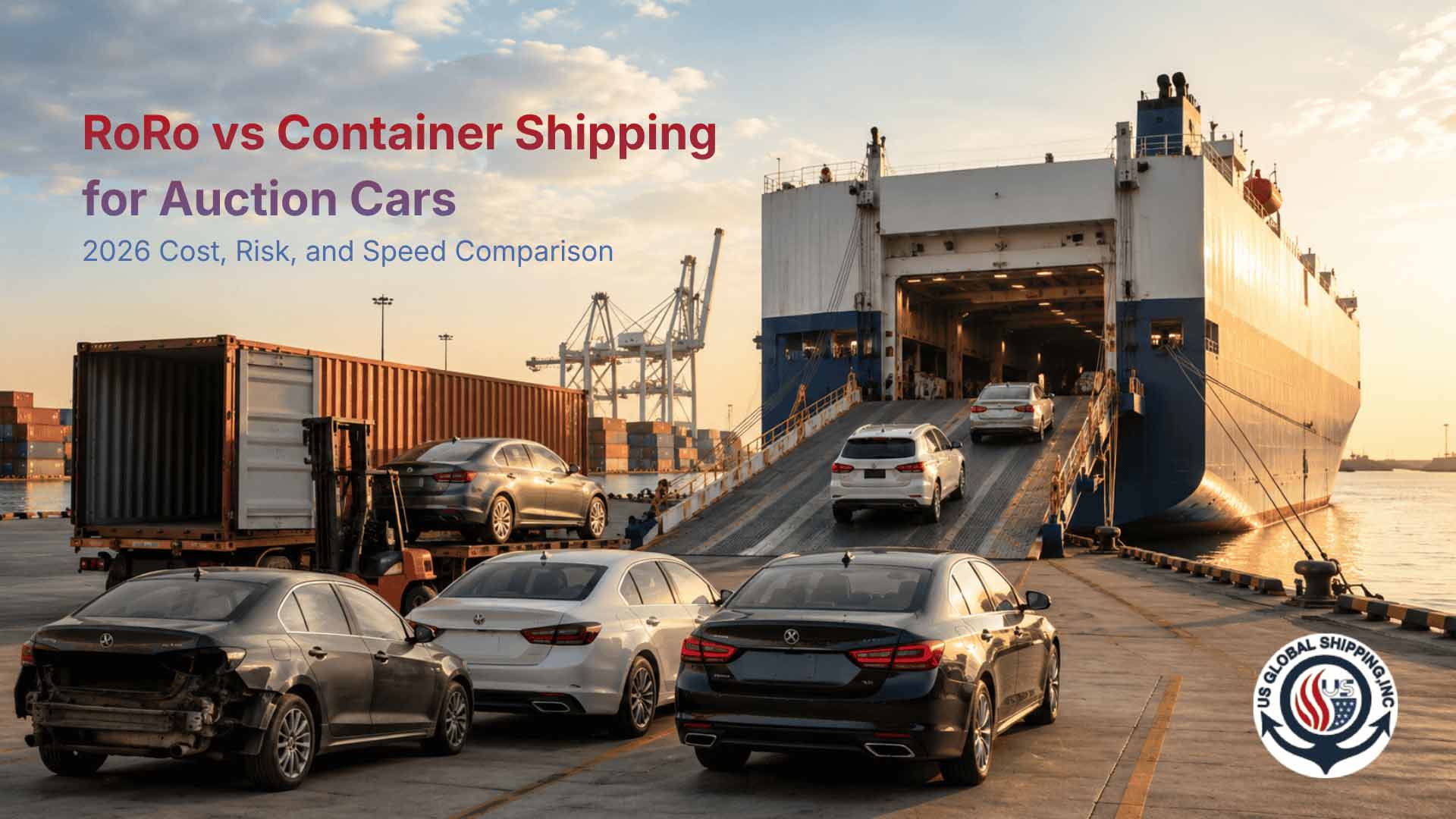
RoRo vs Container Shipping for Auction Cars: 2026 Cost, Risk, and Speed Comparison
RoRo vs Container Shipping for Auction Cars: 2026 Cost, Risk, and Speed Comparison
RoRo shipping is cheaper and faster for running auction cars, with rates from $950 to $2,200 per vehicle. Container shipping is required for non-running, salvage, flood, or high-value vehicles, costs $1,400 to $5,800, and offers better security. For dealers shipping multiple cars to one destination, a 40-foot container delivers the lowest per-vehicle cost.
Which Shipping Method Wins for Your Auction Car?
When you win a vehicle at Copart, IAAI, Manheim, or ADESA, you have two real ocean shipping options: roll-on/roll-off (RoRo) or container. The wrong choice can add hundreds or thousands of dollars to your landed cost — or block your shipment entirely.
- RoRo wins on price for single, running, standard-sized cars.
- Container wins on protection for non-running cars, salvage titles, flood cars, EVs, and high-value vehicles.
- 40-foot container wins on cost-per-vehicle when you ship 2–4 cars to the same destination.
- RoRo wins on speed because sailings follow fixed schedules with no consolidation wait.
The rest of this guide breaks down the comparison by cost, security, vehicle eligibility, and destination — including specific cost ranges for shipping to West Africa, Europe, and Central America.
What Is RoRo Shipping and How Does It Work for Auction Cars?
RoRo (roll-on/roll-off) shipping uses specialized vessels with built-in ramps. Auction cars are driven directly onto multiple decks, secured with chains, and rolled off at the destination port. No container is needed. This method requires that the vehicle starts, drives, steers, and brakes.
RoRo vessels are purpose-built for wheeled cargo — passenger cars, trucks, SUVs, vans, motorcycles, and heavy equipment. Because the cargo moves under its own power, there is no container hire, no port stuffing labor, and no forklift handling. That cost reduction is the primary reason RoRo is the default method for international auction car exports from the United States.
Key features of RoRo shipping
- Drivable only: The vehicle must be fully operational. Carriers reject cars that fail their pre-loading inspection.
- Fixed schedules: RoRo vessels sail on weekly or biweekly rotations, so your transit time is predictable.
- Lower destination charges: RoRo terminals usually carry lower port handling fees than container terminals at the same destination.
- Covered but not sealed: Vehicles travel on decks that are roofed but exposed to humidity, salt air, and ambient temperature.
- No personal items: Most RoRo carriers strictly prohibit loose items inside the vehicle.
What Is Container Shipping and How Does It Work for Auction Cars?
Container shipping loads auction cars into a sealed 20-foot or 40-foot steel container at a US export warehouse. The container is then placed on an ocean vessel. A 20-foot container holds one vehicle. A 40-foot container holds two to four vehicles depending on size. Containers accept non-running, salvage, and damaged vehicles.
Container shipping is the only option for vehicles that cannot be driven onto a RoRo vessel — and the preferred option for any auction car where security, weather protection, or cargo consolidation matters more than headline price.
The three container options
- FCL 20-foot container: One full container dedicated to your shipment. Fits a single standard car comfortably. Used for high-value or oversized vehicles that need their own space.
- FCL 40-foot container: One full container, but large enough to fit 2 sedans, 3 mid-size cars, or up to 4 small vehicles using specialized loading techniques (racking systems or stacking).
- LCL (less than container load): Your car shares a container with cargo from other shippers. Lower upfront cost than FCL but slower because the container must wait until fully consolidated before sailing.
US Global Shipping handles all three configurations — see our full container load and less than container load service pages for handling specifications.
RoRo vs Container Shipping: Side-by-Side Comparison (2026)
This table summarizes the trade-offs across the four shipping configurations available to international auction buyers.
| Factor | RoRo Shipping | Container (LCL) | Container (FCL 20') | Container (FCL 40') |
|---|---|---|---|---|
| Cost Range (per vehicle) | $950 – $2,200 | $1,400 – $2,800 | $2,200 – $4,500 | $2,500 – $5,800 |
| Best For | Running, standard vehicles | Single non-runner or salvage car | 1–2 vehicles + parts | 2–4 vehicles, dealer loads |
| Non-Running Vehicles | Not accepted | Accepted | Accepted | Accepted |
| Salvage / Flood Cars | Restricted by carrier | Accepted | Accepted | Accepted |
| Personal Items Allowed | No | Limited | Yes | Yes |
| Transit Time | Faster (fixed schedule) | Slower (consolidation wait) | Standard | Standard |
| Security / Theft Risk | Higher (open deck) | Lower (sealed) | Lowest (sealed + locked) | Lowest (sealed + locked) |
| Weather Exposure | Some (covered deck) | None | None | None |
| Destination Port Charges | Lower | Higher | Higher | Higher |
| Cost-Per-Vehicle (multi-car load) | Fixed per unit | Shared, but limited | Drops with 2 cars | Lowest with 4 cars |
Note: Cost ranges are 2026 market averages for US-origin shipments. Actual quotes vary by US loading port, destination port, vessel availability, fuel surcharges, and vehicle dimensions. Request a free consultation for a quote specific to your auction win.
Cost Breakdown: RoRo vs Container by Destination (2026)
Shipping costs depend heavily on the destination lane. The following tables show realistic 2026 ranges for the three highest-volume corridors served by US Global Shipping. All figures are per vehicle, in USD, and exclude US-side inland transport (auction yard to port) and destination clearance charges.
West Africa: Nigeria, Ghana, Benin
LANE SNAPSHOT
West Africa is the highest-volume US auction car export corridor. Lagos (Apapa, Tin Can Island), Tema (Ghana), and Cotonou (Benin) all receive frequent RoRo and container service from US East Coast and Gulf ports. RoRo is the default for running vehicles. Container is standard for salvage and flood cars, which represent a large share of Nigerian and Ghanaian auction imports.
| Destination Port | RoRo (running) | Container (LCL/shared) | Transit Time (avg) |
|---|---|---|---|
| Lagos, Nigeria (Apapa/Tin Can) | $1,150 – $1,950 | $1,800 – $2,800 | 30 – 45 days |
| Tema, Ghana | $1,200 – $2,100 | $1,850 – $2,900 | 30 – 45 days |
| Cotonou, Benin | $1,250 – $2,150 | $1,900 – $2,950 | 32 – 48 days |
For destination-specific documentation, salvage import rules, and clearance procedures, see our complete guide to shipping cars from US auctions to West Africa.
Europe: Germany, Poland, Lithuania
LANE SNAPSHOT
European auction car imports skew toward German, Polish, and Lithuanian buyers who specialize in re-registering US-spec vehicles for the EU market. Bremerhaven, Gdynia, and Klaipeda are the dominant RoRo and container hubs. EU regulations restrict some salvage and flood imports, and electric vehicles face additional lithium-battery handling rules.
| Destination Port | RoRo (running) | Container (LCL/shared) | Transit Time (avg) |
|---|---|---|---|
| Bremerhaven, Germany | $1,050 – $1,750 | $1,650 – $2,650 | 18 – 28 days |
| Gdynia, Poland | $1,150 – $1,850 | $1,750 – $2,750 | 22 – 32 days |
| Klaipeda, Lithuania | $1,200 – $1,950 | $1,850 – $2,850 | 24 – 34 days |
Full documentation and EU import details are covered in our Copart and IAAI car shipping to Europe guide.
Central America: Honduras, Guatemala, El Salvador
LANE SNAPSHOT
Central American buyers source heavily from Texas, Florida, and California auctions. Puerto Cortes (Honduras), Puerto Quetzal (Guatemala), and Acajutla (El Salvador) accept RoRo and container traffic. RoRo dominates for running used cars. Container is preferred for dealers shipping multiple vehicles or for salvage and rebuildable inventory.
| Destination Port | RoRo (running) | Container (LCL/shared) | Transit Time (avg) |
|---|---|---|---|
| Puerto Cortes, Honduras | $1,100 – $1,850 | $1,700 – $2,650 | 12 – 20 days |
| Puerto Quetzal, Guatemala | $1,150 – $1,950 | $1,750 – $2,750 | 14 – 22 days |
| Acajutla, El Salvador | $1,200 – $2,000 | $1,800 – $2,800 | 14 – 22 days |
Country-specific duty rates, bilingual documentation, and step-by-step clearance procedures are covered in our auction car shipping to Central America guide.
When to Choose RoRo for an Auction Car
Choose RoRo when your auction car is fully operational, you are shipping a single standard-size vehicle, your destination has weekly or biweekly RoRo service, and lowest single-unit price is your primary goal. RoRo is the wrong choice for non-runners, salvage cars, oversized vehicles, or any shipment where you need to load personal items.
RoRo is the most common method used by international auction car buyers because the majority of Copart, IAAI, Manheim, and ADESA inventory is drivable. The pre-loading inspection by the RoRo carrier is non-negotiable: if the car cannot start, steer, brake, and roll under its own power at the port terminal, it will be rejected.
RoRo is ideal when:
- The vehicle is a running, standard-size passenger car or SUV.
- You are shipping one vehicle, not a multi-car load.
- Your destination port has frequent RoRo calls (Lagos, Bremerhaven, Jebel Ali, Puerto Cortes, etc.).
- You want a predictable sailing date and faster total transit.
- You do not need to ship parts, tools, or household items with the car.
When to Choose Container Shipping for an Auction Car
Choose container shipping when your auction car is non-running or has a salvage or flood title, you are shipping multiple cars to one destination, the vehicle is high-value or rare, or you need to ship personal items inside the car. A 40-foot FCL holding two to four vehicles delivers the lowest per-vehicle cost for dealer-level shipments.
Container shipping accounts for a large portion of US auction car exports because so much auction inventory is non-running, damaged, or salvage. Containers also provide the only practical way for international dealers to consolidate multiple vehicles into a single shipment with one bill of lading, one customs entry, and one set of port handling charges.
Container shipping is ideal when:
- The vehicle does not start, has missing components, or is structurally damaged.
- The title is salvage, flood, theft recovery, or otherwise branded.
- You are shipping 2 or more vehicles to the same destination port.
- The vehicle is high-value (classics, exotics, low-mileage trims, EVs).
- You want to ship personal items, parts, or tools alongside the car.
- Your destination port has limited or no RoRo service.
Decision Matrix: RoRo or Container?
Use this matrix as a fast filter. If your shipment has any container-side trigger, container is almost always the correct choice — even when RoRo looks cheaper on paper, the wasted booking, rejection, and re-routing fees on a non-eligible vehicle will exceed the price gap.
| Choose RoRo If… | Choose Container If… |
|---|---|
| Vehicle starts, drives, steers, and brakes | Vehicle is non-running, damaged, or salvage |
| You are shipping a single, standard car | You are shipping 2 or more cars to one destination |
| You want the lowest single-vehicle quote | You want the lowest per-vehicle cost on multi-car loads |
| You are shipping to a port with regular RoRo service | Your destination port lacks frequent RoRo calls |
| You don't need to ship personal items with the car | You want to load tools, parts, or household items inside |
| The car is standard size, not oversized | Vehicle is high-value, classic, EV, or needs maximum security |
Special Cases: Salvage, Non-Running, EVs, and High-Value Auction Cars
Salvage and flood cars from Copart and IAAI
Salvage and flood vehicles dominate auction inventory headed to West Africa and Central America. Some RoRo carriers will accept salvage cars that still drive, but many refuse — particularly for flood-damaged units where electrical systems are unreliable. Container shipping eliminates the carrier rejection risk and is the standard recommendation for any salvage-titled auction car.
Non-running vehicles
If the auction listing flags the car as non-running, do not book RoRo. The carrier inspection will reject the vehicle, you will lose the booking fee, and you will incur storage charges at the port while the shipment is re-routed. Book container from the start and use a forklift-load arrangement at a certified export warehouse.
Electric vehicles (Tesla, Rivian, Lucid, Ford EVs)
Electric vehicles from US auctions have specific lithium-battery handling rules that are tightening every year. Several major RoRo carriers now restrict damaged-battery EVs entirely. Container shipping in a dedicated 20-foot or 40-foot FCL is generally the safer route for damaged EVs because the battery can be inspected, declared, and packaged in compliance with IMDG dangerous-goods regulations.
High-value, classic, and exotic vehicles
Any vehicle worth more than $40,000 should ship in a sealed container. Open-deck exposure on RoRo creates risk from theft, weather, and incidental handling damage that maritime liability ($500 cap under the Carriage of Goods at Sea Act) will not cover. Pair container shipping with full marine cargo insurance for full protection.
How US Global Shipping Handles Both Methods
US Global Shipping has operated as an FMC-licensed Non-Vessel-Operating Common Carrier (NVOCC) for more than 20 years, specializing in auction car exports from the United States to international markets. Three operational advantages directly affect your RoRo vs container decision:
- Direct buyer accounts at Copart, IAAI, Manheim, and ADESA. We can purchase, dispatch, and load on your behalf without requiring you to hold a US dealer license — eliminating one of the biggest blockers for international buyers.
- FMC NVOCC status. We are listed in the Federal Maritime Commission's verified registry, which means we issue our own house bills of lading, contract directly with vessel operators, and are accountable under FMC regulations. Verifiable credentials reduce your fraud risk.
- Auto dispatch coordination. Inland transport from the auction yard to the export port is one of the most error-prone legs of an international auction shipment. We coordinate auto dispatch transportation directly with the auction houses, so your car moves to the correct port for your chosen RoRo or container method without re-routing.
Our Greensboro, NC head office and our Amman, Jordan office allow us to coordinate origin and destination on the same operational team.
Step-by-Step Process: From Copart or IAAI Win to Destination Port
The end-to-end workflow is the same regardless of method — only the loading step differs.
- Auction win and payment. You win a vehicle on Copart, IAAI, Manheim, or ADESA. Payment is due within the auction's stated window (usually 2 business days).
- Title processing. The auction house releases the title once payment clears. The title is the single most important document for international export — without it, the car cannot be cleared by US Customs.
- Inland transport (auto dispatch). The vehicle is picked up from the auction yard and transported to the US export port that matches your shipping method (RoRo terminal or container stuffing warehouse).
- US export clearance. Customs and Border Protection requires advance filing through the Automated Export System (AES). Your forwarder files the Electronic Export Information (EEI) and submits the title for VIN verification at least 72 hours before vessel departure.
- Loading. For RoRo, the vehicle is driven onto the vessel by terminal staff. For container, the vehicle is loaded into the container at an export warehouse, secured with chocks and straps, and the container is sealed and trucked to the port.
- Ocean transit. RoRo follows fixed sailing schedules. Container follows the vessel's loop. Transit time depends on the lane (see destination tables above).
- Destination port arrival. The vehicle arrives at the receiving port. Container shipments require a container terminal; RoRo shipments discharge at a RoRo berth.
- Destination clearance. Local customs duties, taxes, and fees are paid by the consignee. Your local clearing agent presents the bill of lading, commercial invoice, and title.
- Vehicle release and final delivery. The vehicle is released to the consignee or final delivery driver.
Frequently Asked Questions
Is RoRo cheaper than container shipping for auction cars?
Yes. For a single running auction car, RoRo is typically $400 to $1,500 cheaper than container shipping on the same lane. The cost gap closes — or reverses — when shipping multiple vehicles together, where a 40-foot container holding three or four cars often delivers a lower per-vehicle cost than three or four separate RoRo bookings.
Can you ship a non-running car via RoRo?
No. RoRo carriers require vehicles to start, steer, brake, and roll under their own power. Non-running cars are rejected at the terminal inspection and must be re-routed to container shipping. If you know the auction car is a non-runner, book container from the start to avoid penalties and delays.
Is container shipping safer than RoRo for valuable cars?
Yes. Container shipping seals the vehicle inside a locked steel box for the entire ocean transit, protecting it from theft, weather, salt spray, and incidental handling damage. RoRo decks are covered but not sealed. For any auction car valued above $40,000 or with sentimental or collector value, container shipping is the safer choice.
How long does RoRo shipping take vs container?
RoRo is usually faster because vessels sail on fixed weekly or biweekly schedules with no consolidation wait. Container LCL shipments add 1 to 3 weeks of consolidation time before the container sails. Total RoRo transit from the US East Coast to West Africa runs 30 to 45 days; the equivalent container LCL runs 40 to 60 days.
Can I ship a salvage car from Copart or IAAI via RoRo?
Sometimes, but it is risky. Many RoRo carriers refuse salvage-titled vehicles or impose strict drivability inspections. Container shipping accepts salvage cars without restriction, which is why most Nigerian, Ghanaian, and Central American buyers ship Copart and IAAI salvage inventory in containers rather than RoRo.
How many cars fit in a 40-foot container?
A standard 40-foot container fits 2 sedans loaded flat. With specialized racking, stacking, or angle-loading, the same container can hold 3 mid-size cars or up to 4 small vehicles. The exact count depends on the size, ground clearance, and condition of each car.
Can I ship personal items inside my auction car?
Only in container shipping. RoRo carriers prohibit loose items inside the vehicle for safety and customs reasons. Container shipping (FCL especially) allows you to ship boxed personal items, parts, and tools alongside the car, though you must declare them on the commercial invoice and observe destination customs rules.
Does RoRo or container have lower destination port charges?
RoRo has lower destination port charges in most markets. Container terminals levy terminal handling charges (THC), demurrage, and unstuffing fees that RoRo terminals avoid. This is part of why RoRo remains attractive even when ocean freight rates are similar.
Do I need a US dealer license to ship a car from Copart or IAAI internationally?
Not if you work with a registered broker. Copart and IAAI restrict direct bidding to licensed dealers, but a licensed broker — such as an FMC NVOCC with direct auction accounts — can purchase, dispatch, and export on your behalf. US Global Shipping holds direct buyer accounts at Copart, IAAI, Manheim, and ADESA for this purpose.
Is FMC licensing important when choosing a car shipper?
Yes. FMC (Federal Maritime Commission) licensing is the US federal credential that distinguishes legitimate NVOCCs from unverified middlemen. An FMC license means the company files tariffs, posts financial bonds, and operates under FMC accountability. Verify any forwarder's status at the FMC OTI list before booking.
Get the Right Quote for Your Auction Car
Choosing between RoRo and container shipping comes down to the specific vehicle, destination, and consolidation opportunity. The fastest way to get a method-specific quote is to share your auction win details (VIN, auction lot, destination port) with our team.
US Global Shipping handles RoRo and container shipments to West Africa, Europe, Central America, the Middle East, and beyond — backed by 20+ years of FMC NVOCC experience and direct buyer accounts at every major US auction. Request a free consultation and we will price both methods so you can compare side by side.