
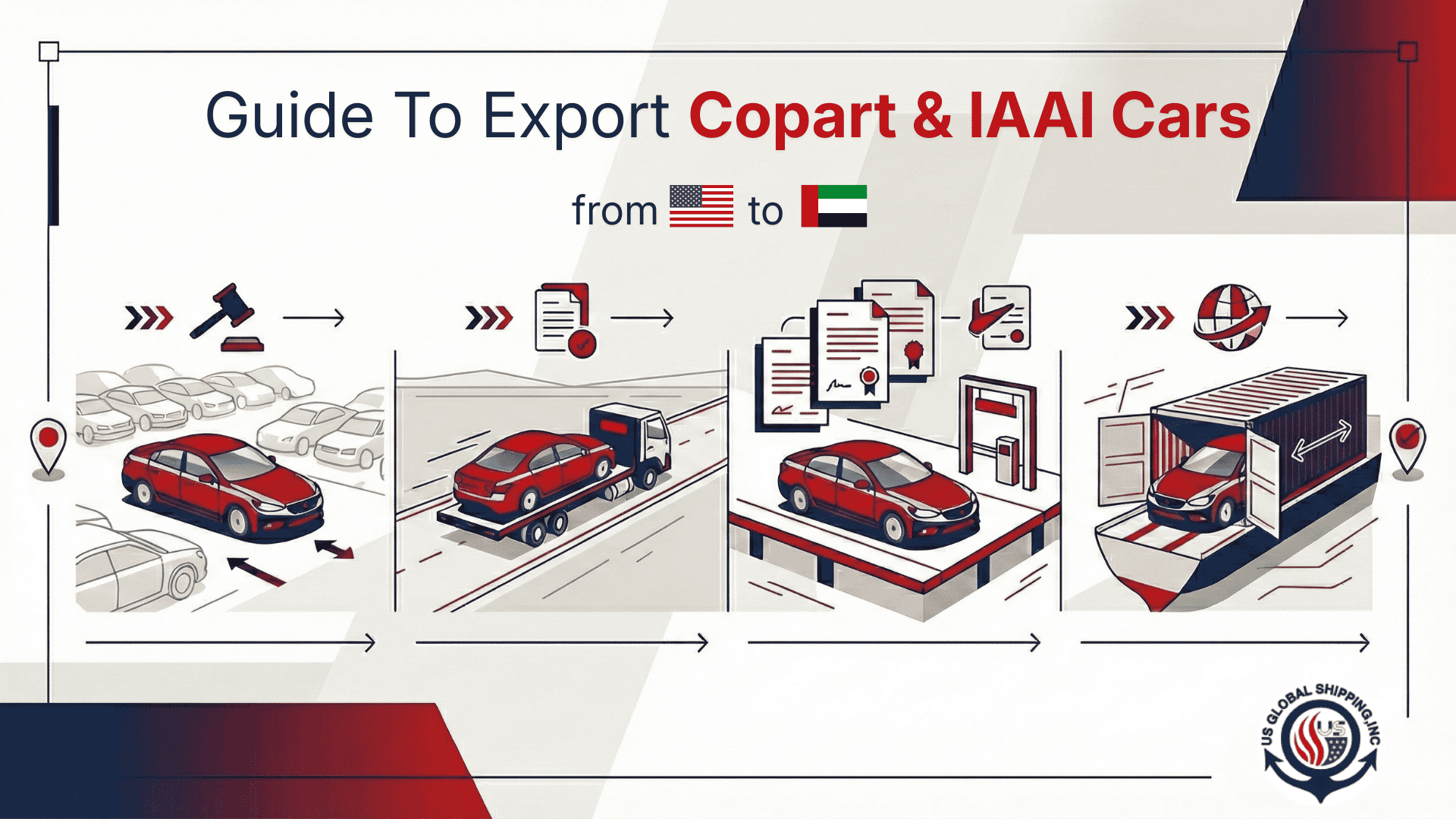
How to Export Copart and IAAI Cars from USA to UAE
A simple, stress-free guide for buyers who don't want costly mistakes
Buying a car from Copart or IAAI feels exciting.
The prices look great.
The inventory is massive.
The bidding is fast.
But the moment you win the auction, a new feeling kicks in.
"Now what?"
That's where most buyers get stuck — not because exporting a car is impossible, but because nobody explains it simply.
This guide does exactly that.
No jargon.
No long lectures.
Just a clear, step-by-step explanation of how to export Copart and IAAI cars from USA to UAE, Saudi Arabia, Qatar, and Jordan.
First, let's clear one big myth
Buying from Copart or IAAI does not automatically mean your car is export-ready.
Winning the auction is only step one.
Exporting the car is a separate process with rules, timelines, and decisions that can either make your shipment smooth… or painfully expensive.
This is why experienced buyers never think in terms of "just shipping".
They think in terms of end-to-end auto export.
That mindset alone saves time, money, and stress.
Step 1: What happens immediately after you win a Copart or IAAI car
Once you win the auction:
- Payment must be completed
- The vehicle must be officially released
- Storage time at the auction yard starts counting
This is the first pressure point.
If the car sits too long at the yard, daily storage fees begin. Many buyers lose money here without realizing it.
This is why serious exporters arrange pickup planning immediately after the auction, not "once everything is ready."
US Global Shipping handles this stage by coordinating auction pickup + inland transport early; before delays start compounding.
Step 2: Moving the car out of the auction yard
Not all cars move the same way.
Some run. Some don't. Some look fine but won't start.
That single detail decides:
- What truck is used
- How much inland transport costs
- Whether RoRo shipping is even possible
If this decision is wrong, the entire export plan collapses later.
This is why buyers who export regularly rely on teams that handle auction vehicles specifically, not general freight.
Step 3: Titles, paperwork, and why exports get "stuck"
This is where most first-time exporters panic.
Here's the truth:
"No car leaves the USA without proper export documentation and title clearance."
That includes:
- Original vehicle title
- Bill of sale
- Export filing (AES/EEI)
- Export authorization
If even one document is missing or delayed, the shipment pauses.
Smart exporters don't rush cars to the port blindly.
They use controlled staging often through warehouses so paperwork is completed before port deadlines.
US Global Shipping supports this flow by managing documentation and timing together, instead of treating them as separate steps.
Step 4: Choosing the right shipping method
There are two main ways to ship auction cars from USA to UAE.
RoRo Shipping (Roll-on / Roll-off)
- Best for running vehicles
- Lower cost
- Faster port handling
Container Shipping
- Best for non-running, damaged cars, salvaged cars or Classic Vintage Cars
- More protection
- Better control for high-value vehicles
Choosing the wrong method doesn't just cost more, it causes re-booking, delays, and extra handling fees.
This is why seasoned auto exporters help buyers decide before the car reaches the port.
US Global Shipping offers both RoRo and container shipping, which allows decisions to be made based on what's best for the vehicle, not what's convenient.
Step 5: Shipping from USA to
Most vehicles ship from major US ports such as:
- Houston
- New Jersey
- Los Angeles
- Savannah
Transit time typically ranges between 25–40 days, depending on routing and destination.
The same export flow also applies when shipping to:
- Saudi Arabia
- Qatar
- Jordan
This is why many buyers prefer a single exporter that understands Middle East auto shipping as a region, not just one country.
Step 6: Arrival in UAE – what importers should actually expect
Most auction cars arrive at Jebel Ali Port.
On arrival:
- Customs clearance is completed
- Duty and VAT are assessed
- Vehicle inspection takes place
- The car is released for delivery or resale
Buyers who planned properly move through this stage smoothly.
Buyers who didn't… usually wish they had asked more questions earlier.
The real reason buyers choose experienced auto exporters
Here's something rarely said out loud:
Exporting cars isn't hard.
Fixing mistakes is.
Most problems happen because buyers:
- Wait too long to arrange pickup
- Don't understand title timelines
- Choose shipping methods blindly
- Work with agents who don't specialize in auction exports
US Global Shipping's strength is not "cheap shipping." It's removing uncertainty from a process that punishes guesswork.
If you're exporting from Copart or IAAI, ask yourself this
- Do I know when my car must leave the auction yard?
- Do I know whether it qualifies for RoRo?
- Do I know when the title will be export-ready?
- Do I know my total landed cost, not just ocean freight?
If the answer to any of these is "not really," that's your cue to schedule a call with reliable shipping partner like US Global Shipping.
Final thought (and this matters)
Exporting Copart and IAAI cars from USA to UAE doesn't need to be stressful.
It just needs:
- The right sequence
- The right decisions
- The right people handling it
US Global Shipping supports buyers shipping vehicles from the USA to UAE, Saudi Arabia, Qatar, and Jordan by managing the process end-to-end i.e; from auction pickup to ocean freight.
If you want your next export to be fast, smooth, and predictable, the smartest step is simply starting the conversation early.