How International Buyers Can Buy from Copart, IAAI, Manheim, and ADESA Without a US Dealer License
How International Buyers Can Buy from Copart, IAAI, Manheim, and ADESA Without a US Dealer License
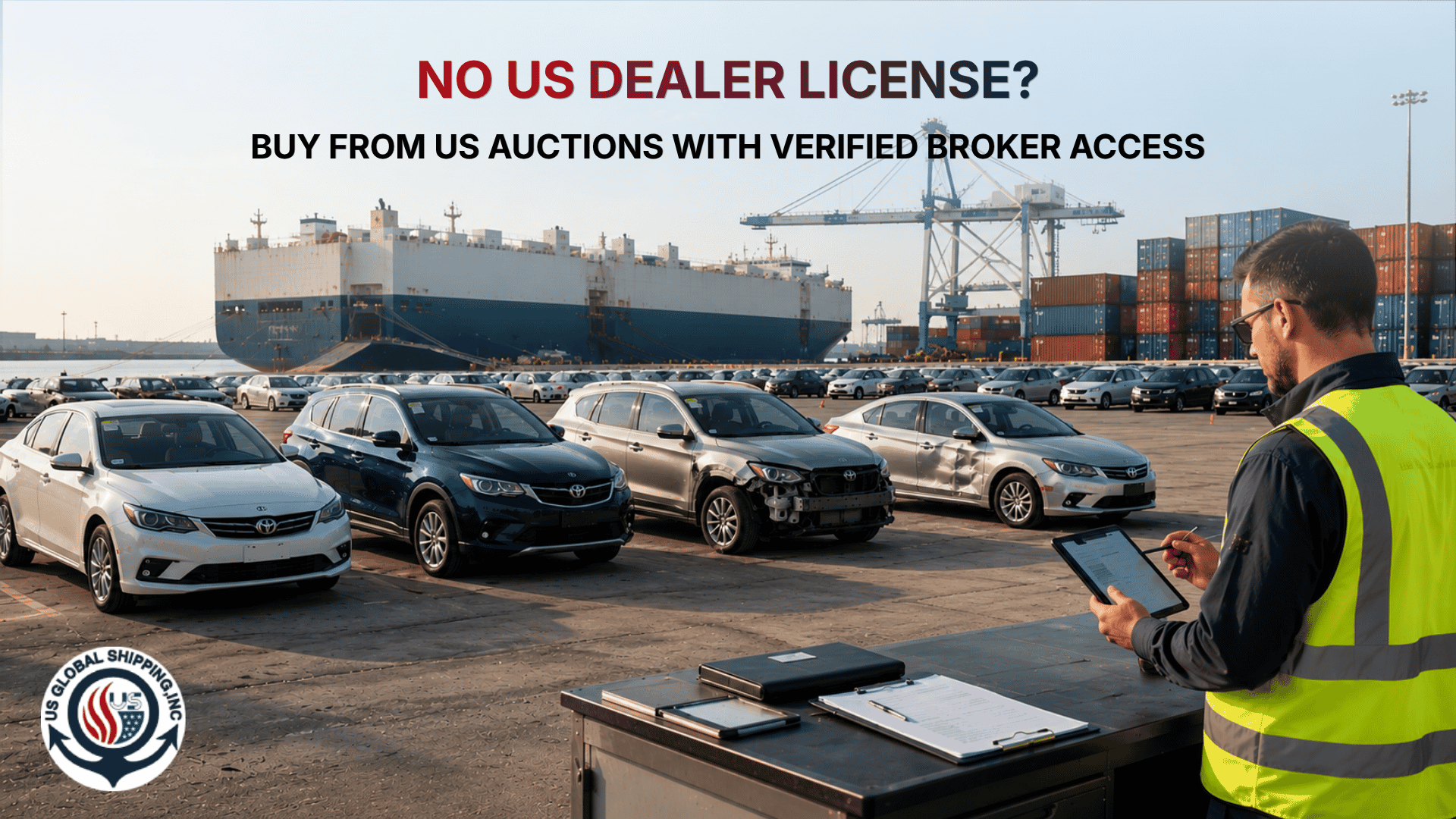
The four major US vehicle auctions all restrict bidding to licensed buyers, each in a slightly different way. For international buyers who do not hold a US dealer license, this looks like a wall. The reality is that a legal, well-established path exists, and every serious international buyer in this market uses it.
When evaluating how to access US auctions from outside the country, weigh:
- Whether your destination needs salvage or clean-title inventory
- Your shipment volume per year
- Your willingness to maintain a US business entity
- The level of US presence you can sustain
- Broker fees versus dealer license costs
- The level of fraud protection you need
- The time you can wait before placing the first bid
- The auctions you actually need to access
Copart and IAAI run limited public-buyer tiers, but most worthwhile inventory at both platforms sits behind dealer-only walls. Manheim and ADESA do not allow public buyers at all. The path most international buyers take is to work through a registered FMC-licensed NVOCC broker that already holds direct buyer accounts at all four auctions and runs the entire workflow under their license.
Getting your own US dealer license is technically possible from outside the country, but the cost, timeline, and operational overhead almost never make sense for buyers importing a few dozen vehicles per year. The broker path is faster, cheaper, and removes the requirement to maintain a US business. The trade-off is choosing a broker the buyer can actually verify, which is where most fraud cases against international buyers begin.
US Global Shipping is an FMC-licensed NVOCC that provides broker access across Copart, IAAI, Manheim, ADESA, and EDGE Pipeline through one USA auction access program.
Why US Auctions Require a Dealer License
The license requirement exists to prevent fraud, ensure tax collection, and verify that buyers operate as legitimate businesses. State DMVs issue dealer licenses individually, with each state setting its own bond, insurance, and physical-presence rules. The framework was never designed with cross-border buyers in mind, which is why international buyers find it difficult to enter directly.
A US dealer license requires a US business entity, a physical commercial address in the state of registration, a surety bond in the range of 10,000 to 50,000 dollars, garage liability insurance, a background check, a US Tax ID, and a US bank account in the business name. Most states also require annual renewal, ongoing tax filings, and continuing physical presence at the registered location.
Total setup cost runs 5,000 to 25,000 dollars, with timelines of 3 to 12 months before the first bid can be placed. Maintaining the license adds annual fees and the operational burden of running a US business from abroad. For an international buyer planning to import a modest annual volume, the math almost never works.
The Three Paths Available to International Buyers
There are exactly three legal ways for an international buyer to purchase from Copart, IAAI, Manheim, or ADESA. Each has trade-offs, but for the majority of buyers, only one path is practical.
Path 1: Registered FMC NVOCC Broker
The broker holds US dealer credentials and direct buyer accounts at each auction. The broker bids on the buyer's behalf, takes title temporarily, then transfers ownership to the buyer once payment clears. The vehicle is exported under the broker's NVOCC license.
This path requires no US business entity, no US address, and no US visa. The broker fee, typically 200 to 600 dollars per vehicle, replaces the cost and complexity of holding a license directly. Account setup takes 1 to 2 business days, and the first bid can be placed almost immediately afterward.
Path 2: Public Membership
Copart sells a Basic Membership for 200 dollars per year that allows public buyers to bid on a limited inventory subset. IAAI permits some public bidding in certain states. Manheim and ADESA do not allow public buyers at all.
Public membership occasionally works for buyers seeking one or two specific clean-title vehicles from the eligible subset. For most international buyers, it is not viable because the buyer must arrange their own US transport, title processing, and export. The worthwhile inventory is mostly excluded, which is the central limitation.
Path 3: Form Your Own US LLC and Dealer License
Some high-volume international buyers, typically dealers importing 100 plus vehicles per year, establish a US LLC, lease a US commercial address, post a surety bond, and obtain a dealer license. This unlocks direct auction access at all four platforms.
The cost is real: 5,000 to 25,000 dollars in setup, plus annual maintenance, US tax compliance, and the operational burden of running a US business from outside the country. The timeline runs 3 to 12 months. For buyers with the volume to justify the overhead, the math can work after the first full year of operation.
| Path | Setup Cost | Time to First Bid | US Presence |
|---|---|---|---|
| Registered Broker | 0 dollars | 1 to 2 days | None required |
| Public Membership | 200 dollars per year | Same day | None required |
| Own US License | 5,000 to 25,000 dollars | 3 to 12 months | Required |
For roughly 95 percent of international buyers, the registered broker path is the right answer.
How Broker Access Works in Practice
The workflow is straightforward once the broker account is set up. The broker bids on the buyer's behalf, handles title and export under their NVOCC license, and ships the vehicle to the destination port. The buyer never needs to enter the United States.
The end-to-end sequence:
- The buyer briefs the broker on destination country, target vehicle class, and budget
- The broker provides inventory listings across Copart, IAAI, Manheim, and ADESA
- The buyer sets maximum bids on selected lots
- The broker bids within the authorized maximums
- After a winning bid, the broker invoices for hammer price, auction fees, and broker fee
- The buyer pays the invoice, usually by wire transfer, within 1 to 3 business days
- The auction releases the title to the broker
- The broker arranges auto dispatch transportation from the auction yard to the export port
- AES export filing and bill of lading are handled under the broker's license
- The vehicle ships by RoRo or container based on the vehicle condition and the destination
- The destination clearing agent processes customs, duties, and final delivery
End-to-end timing typically runs 45 to 90 days from first contact to vehicle arrival at the destination port, with the bulk of that being ocean transit.
How to Verify a Legitimate Broker
The single most important due-diligence step is verifying the broker's FMC NVOCC license. This is the federal credential that distinguishes legitimate ocean freight forwarders from unregulated middlemen, and the verification process takes less than five minutes.
Go to fmc.gov and use the Ocean Transportation Intermediary lookup tool. Search the broker's company name or NVOCC number. Confirm the listed name matches the broker, the status is Active, the address is verifiable, and the license type is NVOCC.
Additional signals worth checking:
- Physical US office address, not a PO Box or mailbox forwarding service
- Active business listing with the state Secretary of State
- Verifiable US phone number answered during US business hours
- Better Business Bureau profile with rating history
- Real client references in the buyer's destination country
- Domain age of at least 3 years
- Independent reviews on Trustpilot, Google Business, or industry forums
Any broker who hesitates to provide an FMC license number, refuses to share a physical address, or demands payment by cryptocurrency or gift card should be treated as a fraud risk and avoided. Wire payment to an unverified broker is the single most common loss pattern reported by international buyers in this space.
Auction-by-Auction Access
Each auction handles non-licensed buyers differently. The broker path unlocks full inventory at all four, but the underlying access rules matter when deciding whether to attempt any direct public access.
| Auction | With Dealer License | With Registered Broker | Public Access |
|---|---|---|---|
| Copart | Full inventory | Full inventory | Limited, 200 dollar Basic Membership |
| IAAI | Full inventory | Full inventory | Varies by state, restricted |
| Manheim | Full inventory | Full inventory | None |
| ADESA | Full inventory | Full inventory | None |
Choosing the right auction for a given destination is a separate decision, and the inventory-mix question is covered in the side-by-side Copart, IAAI, Manheim, and ADESA comparison for international buyers.
Documents the Broker Will Ask For
Broker account setup is significantly simpler than getting a US dealer license. The standard requirements include a government-issued photo ID such as a passport, proof of address from a utility bill or bank statement, the destination country address, a signed broker authorization letter, and an initial refundable deposit.
No US visa, US business registration, or in-person visit is required. The entire process from account setup to vehicle delivery happens remotely, with communication by email, phone, and digital signatures. Most international buyers complete setup within 1 to 2 business days.
Why International Buyer Auction Purchases Fail
Most failed auction purchases by international buyers are preventable. The common failures include:
- Sending payment to an unverified broker without checking the FMC OTI list
- Buying inventory the destination country will not accept
- Underestimating storage fees that ramp within days of the sale
- Missing payment deadlines and losing the bid plus the deposit
- Picking a broker with access to only one or two of the four auctions
- Ignoring the production year versus model year distinction at the destination
- Using cryptocurrency or non-traceable payment methods
- Skipping the buyer letter or gate authorization at IAAI
These failures rarely appear as a single dramatic loss. They compound across a series of transactions until the buyer realizes the wrong process choices have been quietly draining margin, or worse, that the broker was never legitimate in the first place.
How US Global Shipping Handles No-License Auction Access
US Global Shipping operates as an FMC-licensed NVOCC with more than 20 years of experience in international auction car exports. The brand approach is to handle bidding, title, transport, and export under one operational team without requiring the buyer to maintain any US presence.
- Direct buyer accounts at Copart, IAAI, Manheim, ADESA, and EDGE Pipeline
- FMC NVOCC license verifiable on the public FMC OTI list at fmc.gov
- Auto export services covering bidding, title, transport, and shipping
- Ocean freight operations across RoRo and container methods
- AES filing and bill of lading under one operational team
- Account setup in 1 to 2 business days with no US presence required
- Offices in Greensboro, NC and Amman, Jordan
The value of working through one broker with access to all four auctions is operational consolidation. The buyer holds one account, receives one invoice flow, and works with one team across multiple auction platforms, multiple export ports, and the destination corridor.
Final Considerations for International Buyers
The broker path is the standard for international auction buyers because it is legal, well-established, and removes the operational burden of running a US business from abroad. The path becomes risky only when the broker is unverified, which is why due diligence at the start of the relationship matters more than any subsequent decision.
A short checklist before sending any money:
- Verify the FMC NVOCC license on fmc.gov
- Confirm the broker holds direct accounts at the auctions you need
- Confirm a verifiable US business address and phone number
- Confirm the broker accepts wire transfer, not cryptocurrency or gift cards
- Confirm the total landed cost matches your resale margin
To set up a broker account and begin sourcing from Copart, IAAI, Manheim, and ADESA, contact the US Global Shipping team for an initial consultation on your destination, target inventory, and shipping plan.
Frequently Asked Questions
Do I need a US dealer license to buy from Copart or IAAI?
Not necessarily. Both Copart and IAAI allow some level of public bidding, but most worthwhile inventory at both platforms is restricted to licensed dealers. The standard path for international buyers is to use a registered FMC NVOCC broker, which unlocks the full inventory at both auctions plus Manheim and ADESA, all without requiring the buyer to hold a license. The broker fee replaces the cost and complexity of obtaining a license directly.
Can I buy from Manheim or ADESA without a dealer license?
Only through a registered broker. Manheim and ADESA do not allow public bidding under any circumstances, so direct access requires a US dealer license and an active dealer account at each auction. International buyers reach this inventory exclusively by partnering with an FMC NVOCC freight forwarder that already operates dealer accounts at both platforms.
How much does it cost to use a broker?
Broker fees typically range from 200 to 600 dollars per vehicle. Copart and IAAI broker fees usually fall in the 200 to 400 dollar range, while Manheim and ADESA broker fees are higher because the dealer account requirements at those platforms are more rigorous. The broker fee replaces the cost and complexity of obtaining a US dealer license.
How do I verify a broker is legitimate?
Search the broker's company name on the Federal Maritime Commission Ocean Transportation Intermediary list at fmc.gov. A valid NVOCC license confirms the broker posts financial bonds, files tariffs, and operates under federal accountability. Cross-check the physical US address, BBB profile, domain age, and client references in your destination country before sending any payment.
Is it legal for international buyers to use a US broker?
Yes. Using a registered FMC NVOCC broker to purchase and export US auction vehicles is fully legal under US law. The broker holds the appropriate state and federal credentials, the title transfers correctly, and the export filing is handled under the broker's NVOCC license. This is the standard route used by thousands of international buyers every month.
Do I need to visit the US to open a broker account?
No. The entire process happens remotely. Account setup, bidding, payment, title transfer, inland transport, export, and ocean shipping all proceed without the buyer traveling to the United States. Communication happens by email, phone, and digital signatures, and most international buyers never visit the US.