Cotonou vs Lagos vs Tema vs Lomé: The West Africa Port Decision Guide for USA Auto Exporters
Cotonou vs Lagos vs Tema vs Lomé: The West Africa Port Decision Guide for USA Auto Exporters
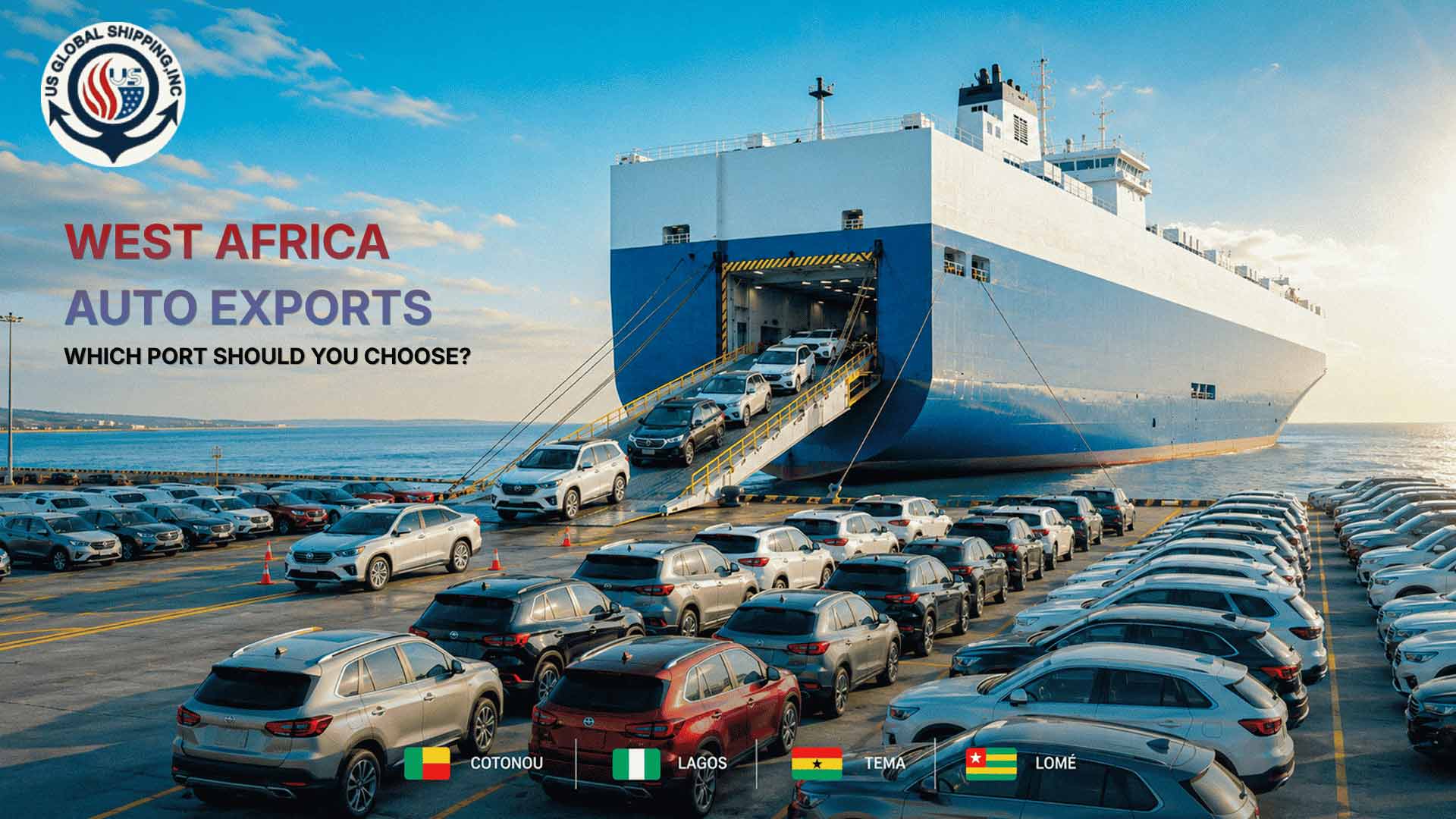
West Africa imports more used vehicles from the United States than any other region of Africa, and four ports handle nearly all of that volume: Cotonou in Benin, Lagos in Nigeria, Tema in Ghana, and Lomé in Togo. Each port has its own duty structure, age rules, clearance timelines, and downstream market. The port you choose determines the landed cost of the vehicle, the buyer base you can sell to, and the time it takes to convert an auction purchase into a delivered unit.
This guide is written for US-based exporters, dealers, and high-volume auction buyers moving Copart, IAAI, Manheim, ADESA, and Edge Pipeline inventory into the West African market. It compares the four dominant ports on the variables that actually drive margin: duty rates, age restrictions, clearance speed, sailing frequency from US ports, and end-market reach.
The West Africa Used Vehicle Trade at a Glance
West Africa is the largest used-vehicle importing region in Africa, accounting for roughly 70 percent of the continent's total used-vehicle volume. The United States is one of its top three supplier markets alongside Japan and the European Union. The flow is dominated by Copart and IAAI salvage and insurance-recovered inventory, supplemented by Manheim wholesale and dealer auction stock.
The four ports below are not isolated markets. Cotonou and Lomé function as gateway ports for regional re-export, particularly into Nigeria, Mali, Burkina Faso, and Niger. Lagos and Tema serve their domestic markets primarily but also feed inland buyers. Understanding which port serves which downstream market is the first step in choosing where to land a vehicle.
The Four Ports That Define West African Vehicle Imports
Cotonou, Benin (Port Autonome de Cotonou)
Cotonou is the most active vehicle import port in West Africa. Estimates from environmental and trade studies place around 85 percent of vehicles cleared at Cotonou as ultimately destined for the Nigerian market via the regional ECOWAS corridor. Benin's import duty structure on used vehicles is materially lower than Nigeria's, which is why a significant share of Nigeria-bound inventory has historically been routed through Cotonou rather than Lagos. Cotonou handles both Ro-Ro and container traffic, with strong sailing frequency from US East Coast ports.
Lagos, Nigeria (Apapa and Tin Can Island)
Lagos is the largest direct-import vehicle market in West Africa by population, but it is the most regulated. Nigeria enforces a 10-year age limit on used passenger vehicle imports, applies a base import duty of 20 percent plus a 15 percent National Automotive Council (NAC) levy, and adds 7.5 percent VAT calculated on the duty-inclusive value. The combined landed tax burden for compliant vehicles is approximately 35 percent of CIF before VAT, before clearing agent fees. Both Apapa and Tin Can Island handle Ro-Ro and container vessels, with documentation processed through the Nigeria Customs Service NICIS II portal and the mandatory Form M and PAAR (Pre-Arrival Assessment Report) framework.
Tema, Ghana
Tema is Ghana's primary vehicle import gateway and one of the most operationally efficient ports in West Africa, processing imports through the Integrated Customs Management System (ICUMS). Ghana enforces a 10-year manufacture-year age limit on used passenger vehicles, with vehicles arriving in 2026 needing to be model year 2016 or newer to avoid the over-age penalty structure imposed by the Ghana Revenue Authority. Over-age vehicles can still enter, but the penalty escalates sharply for vehicles 13 years and older. Tema also handles a meaningful share of West Africa's collector and classic vehicle imports.
Lomé, Togo
Lomé operates similarly to Cotonou as a transit hub. Trade studies estimate around 75 percent of Togo's vehicle imports are ultimately re-exported into Nigeria, Mali, Burkina Faso, and Niger via ECOWAS land corridors. Togo applies a lower and more flexible duty structure than Nigeria or Ghana, which is the structural reason it remains commercially attractive despite its smaller domestic market. Lomé handles both Ro-Ro and container traffic and is served by multiple weekly sailings from US East Coast ports.
West Africa Port Comparison: Side-by-Side
| Factor | Cotonou (Benin) | Lagos (Nigeria) | Tema (Ghana) | Lomé (Togo) |
|---|---|---|---|---|
| Domestic market size | Small | Largest in region | Mid-size | Small |
| Used vehicle age limit | No strict age cap | 10 years (model year 2016+ for 2026) | 10 years standard, age penalties beyond | Flexible, no strict age cap |
| Base import duty (used vehicle) | Lower, structured around CFA fixed levies | 20% duty + 15% NAC levy | ~5 to 20% duty bands based on engine and age | Lower, flexible structure |
| VAT / additional taxes | Minimal additional layer | 7.5% VAT on duty-inclusive value | 12.5% VAT plus levies | Minimal additional layer |
| Salvage and non-running vehicles | Accepted (container) | Accepted (container) | Accepted with documentation | Accepted (container) |
| Primary downstream market | Nigeria (~85% via regional corridor) | Domestic Nigeria | Domestic Ghana plus inland West Africa | Nigeria, Mali, Burkina Faso, Niger |
| Customs system | Benin Customs | Nigeria Customs (NICIS II, Form M, PAAR) | ICUMS (Ghana Revenue Authority) | Togo Customs |
| Container traffic | High frequency | High frequency | High frequency | High frequency |
| Ro-Ro traffic | High frequency | High frequency | Moderate to high | High frequency |
| Pre-shipment inspection | Variable | Required (SONCAP, VIN Valuation) | Required (G-CAP) | Variable |
| Typical clearance time | 3 to 10 days | 7 to 21 days | 5 to 14 days | 3 to 10 days |
Country-by-Country Import Rules
Nigeria
Nigeria's used vehicle import regime is the most restrictive of the four. The Nigeria Customs Service enforces a 10-year age limit calculated from the year of manufacture, not the date of first registration. For shipments arriving in 2026, the vehicle must be model year 2016 or newer to qualify for standard entry.
The duty stack is layered:
- 20 percent base import duty
- 15 percent National Automotive Council (NAC) levy
- 7.5 percent VAT applied to the duty-inclusive value
- ECOWAS Trade Liberalisation Scheme (ETLS) levy
- Comprehensive Import Supervision Scheme (CISS) charge
Documentation includes Form M approval before vessel arrival, a Pre-Arrival Assessment Report (PAAR), SONCAP conformity assessment, and VIN Valuation. Missing or mismatched documentation is the single largest source of demurrage at Apapa and Tin Can Island.
For US exporters working with our USA Auction Access service on Nigeria-bound inventory, the practical implication is straightforward: the vehicle must be a 2016 or newer model year, and the export documentation must align perfectly with the Form M before the container or Ro-Ro vessel departs the US port.
Benin
Benin operates under the ECOWAS Common External Tariff (CET), but its national application is materially more flexible than Nigeria's. Benin does not enforce a strict age cap on used passenger vehicles, which is the primary structural reason it has become the dominant transit port for older inventory. The duty structure is built around CFA-denominated levies that, in aggregate, run lower than Nigeria's combined duty stack for most vehicle classes.
For US exporters, Benin is the practical landing point for inventory that would not qualify for direct Nigeria entry under the 10-year rule. Onward movement to Nigeria via ECOWAS land corridors is a regulated activity governed by both Beninese export procedure and Nigerian Customs Service border enforcement. Compliant onward movement requires a Nigerian-licensed clearing agent and full duty payment at the Nigerian end. Exporters should work only with consignees who handle this legitimately.
Ghana
Ghana's Ghana Revenue Authority (GRA) enforces a 10-year manufacture-year age limit through the ICUMS system. Vehicles arriving in 2026 must be model year 2016 or newer for standard entry. Older vehicles are not banned outright but enter an escalating penalty band that can add 5 to 50 percent to the duty base depending on age, vehicle type, and engine displacement.
The base duty structure for compliant vehicles runs approximately 5 to 20 percent depending on engine size, plus 12.5 percent VAT and additional levies including NHIL, GETFL, and COVID-19 levies. The combined effective tax burden on a compliant used vehicle typically lands in the 35 to 40 percent range of CIF value.
Pre-shipment requirements include a Ghana Conformity Assessment Programme (G-CAP) certificate, AES filing 72 hours before vessel departure, and a valid title or bill of sale. Tema's ICUMS system is digital and audit-tracked, which reduces clearance uncertainty for properly documented shipments but flags undervalued declarations automatically.
Togo
Togo applies the ECOWAS Common External Tariff with a national interpretation that historically favors transit trade. There is no strict age cap on used passenger vehicle imports, and the effective duty burden is among the lowest in the region. Lomé's structural position is similar to Cotonou's: it is a transit hub for inventory destined for landlocked West African markets and for Nigeria via regional corridors.
For US exporters, Lomé is particularly relevant for inventory destined for Mali, Burkina Faso, and Niger, where the inland route via Lomé is the established commercial corridor.
Transit Times from US Ports to West Africa
Transit times depend on the US departure port, the destination port, and the carrier's vessel rotation. The ranges below reflect typical ocean transit for the West Africa lane, excluding inland US transport from the auction yard to the export port and excluding destination customs clearance.
| US Departure Port | Cotonou | Lagos (Apapa) | Tema | Lomé |
|---|---|---|---|---|
| Baltimore | 22 to 30 days | 25 to 33 days | 22 to 30 days | 22 to 30 days |
| New York / Newark | 22 to 30 days | 25 to 33 days | 22 to 30 days | 22 to 30 days |
| Norfolk | 24 to 32 days | 27 to 35 days | 24 to 32 days | 24 to 32 days |
| Charleston | 24 to 32 days | 27 to 35 days | 24 to 32 days | 24 to 32 days |
| Savannah | 24 to 32 days | 27 to 35 days | 24 to 32 days | 24 to 32 days |
| Jacksonville | 24 to 32 days | 27 to 35 days | 24 to 32 days | 24 to 32 days |
| Houston | 30 to 40 days | 33 to 42 days | 30 to 40 days | 30 to 40 days |
East Coast departures consistently offer the shortest transit times to West Africa. Vehicles sourced from Copart and IAAI yards in the Mid-Atlantic, Southeast, and Northeast US should generally route through Baltimore, Newark, Norfolk, or Jacksonville for the most efficient transit. Coordinating inland transportation from the auction yard to the export port is often where 3 to 10 days of avoidable delay enters the timeline, so the dispatch leg deserves as much planning attention as the ocean leg.
Vehicle Eligibility by Destination
The eligibility filter is the first decision the exporter has to make, and it differs sharply by port.
What Each Port Will Accept
| Vehicle Type or Condition | Cotonou | Lagos | Tema | Lomé |
|---|---|---|---|---|
| Running passenger vehicle, 2016 or newer | Yes | Yes | Yes | Yes |
| Running passenger vehicle, 2011 to 2015 | Yes | No (over 10-year limit) | Penalty band | Yes |
| Running passenger vehicle, older than 2011 | Yes | No | High penalty band | Yes |
| Salvage title vehicle (running) | Yes (container) | Yes if within age limit | Yes if within age limit | Yes (container) |
| Salvage title vehicle (non-running) | Yes (container) | Yes if within age limit | Yes if within age limit | Yes (container) |
| Heavy equipment, construction machinery | Yes | Yes | Yes | Yes |
| Commercial trucks | Yes | Yes (with own rules) | Yes | Yes |
| EVs and hybrids | Variable | Variable | Variable | Variable |
The structural insight is that Cotonou and Lomé absorb older inventory that Lagos and Tema cannot. For high-volume Copart and IAAI exporters whose auction mix skews toward older salvage units, Benin and Togo are often the only commercially viable landing points.
Shipping Method Considerations by Port
All four ports handle both Ro-Ro and container traffic, but the practical method choice shifts by port and by inventory type.
Container shipping is the default for:
- Salvage-title and non-running vehicles, which represent the majority of Copart and IAAI inventory
- Shipments where parts, tires, or personal effects are loaded with the vehicle
- High-value, classic, or modified vehicles that need maximum protection
- Multi-vehicle consolidation, where 2 to 4 vehicles share a 40-foot container
Ro-Ro shipping is preferred for:
- Running, clean-title vehicles being shipped as single units
- Heavy equipment and oversized vehicles that exceed container dimensions
- Cost-sensitive shipments where the per-vehicle Ro-Ro rate beats single-vehicle FCL
For exporters moving 2 or more vehicles in the same window, consolidated container shipping through our FCL service typically delivers the lowest per-vehicle landed cost on the West Africa lane. For single running clean-title units bound for Tema or Apapa, Ro-Ro often wins.
Strategic Port Selection: A Decision Framework
Use the following five-step framework to assign each shipment to the right port.
Step 1: Identify the final buyer's market. If the buyer is in Nigeria and the vehicle is 2016 or newer with full compliance documentation, Lagos is the direct option. If the buyer is in Nigeria and the vehicle is older or non-compliant, the regional corridor via Cotonou is the historical route, contingent on the buyer working with a legitimate Nigerian clearing agent at the border. If the buyer is in Ghana, Tema is the destination. If the buyer is in Mali, Burkina Faso, or Niger, Lomé is the established corridor.
Step 2: Filter by vehicle age. If the vehicle is older than 10 years and the buyer is in Nigeria or Ghana, the direct-port option is closed. Cotonou or Lomé become the only commercially viable landing points.
Step 3: Filter by vehicle condition. Non-running and salvage vehicles must move by container regardless of destination port. This is a Ro-Ro disqualifier across all four ports.
Step 4: Filter by total landed cost. Calculate CIF, duty, levies, VAT, port charges, clearance fees, and inland transport at destination. For Nigeria, the Form M and PAAR process means duty is essentially locked in before arrival, which makes cost forecasting tighter than for the other three ports. For Ghana, ICUMS valuation means undervalued declarations are flagged automatically.
Step 5: Optimize the US departure port. Match the auction location to the closest East Coast export port. A Copart or IAAI yard in the Carolinas should not route to Houston. The inland leg is where avoidable cost and time are most often added.
Common Mistakes USA Exporters Make on the West Africa Lane
These are the recurring operational failures we see in the market. Each one is avoidable with documentation discipline.
- Misreading the model year on the auction listing. Auction listings sometimes display the first-registration year rather than the year of manufacture. Nigeria and Ghana customs both use the year of manufacture from the VIN. Verify the VIN-derived build date before purchasing for either market.
- Skipping the SONCAP, G-CAP, or PAAR pre-clearance. Pre-shipment documentation has to be initiated before the vessel sails, not after arrival. Late documentation produces demurrage in days, not hours.
- Routing salvage inventory to Ro-Ro. Salvage Copart vehicles are almost never operational. They cannot be driven onto a Ro-Ro vessel. Booking Ro-Ro for a non-running salvage car results in the vehicle being rejected at the loading port.
- Undervaluing declared CIF. Ghana's ICUMS automatically flags undervalued declarations. Nigeria's PAAR cross-references declared value against market data. Undervaluation is no longer a viable strategy in either market.
- Choosing the wrong US departure port. Routing a Mid-Atlantic auction vehicle through a Gulf or West Coast port adds 7 to 14 days of unnecessary transit. Origin-port selection should match auction location.
- Misunderstanding the Cotonou-to-Nigeria route. The land movement from Benin to Nigeria is a regulated process requiring full Nigerian duty payment at the border. Exporters should not arrange this informally and should only work with Nigerian buyers who have a licensed clearing agent.
Documentation Checklist for the West Africa Lane
The following documents are required across most West Africa shipments. Specific country requirements layer on top.
- Original vehicle title or certificate of origin
- Bill of sale or auction purchase invoice
- AES filing with valid ITN (mandatory for US export)
- Commercial invoice with declared CIF value
- Packing list (for container shipments)
- Bill of lading
- Power of Attorney if applicable
- Pre-shipment conformity certificate where required (SONCAP for Nigeria, G-CAP for Ghana)
- Form M for Nigeria-bound shipments
- VIN inspection record
For exporters running consistent monthly volume through our Auto Dispatch Transportation and Auction Access services, this documentation chain is coordinated as a single workflow from auction win to vessel departure, which removes the most common source of West Africa lane delays.
Practical Recommendations for High-Volume Exporters
Three operational habits separate efficient West Africa exporters from inefficient ones.
First, consolidate purchases by destination port and sailing week. A buyer with four vehicles bound for Cotonou should not ship them on four separate Ro-Ro bookings. Holding them in a near-port warehouse for 5 to 7 days to consolidate into a single 40-foot container almost always wins on landed cost.
Second, segregate inventory by age compliance at the auction-buying stage. A simple internal rule of "2016 or newer goes to Lagos or Tema, anything older goes to Cotonou or Lomé" prevents the most expensive single mistake on this lane: a vehicle blocked at customs because it was routed to the wrong port.
Third, pre-stage your documentation 14 days before the vessel sails. Form M, SONCAP, G-CAP, and PAAR are not last-minute documents. Treating them as such is the single most common reason ocean bookings get pushed to the next sailing.
Frequently Asked Questions
Why do so many Nigeria-bound cars go through Cotonou instead of Lagos?
Benin does not enforce the same 10-year age limit as Nigeria and applies a materially lower duty structure on used vehicles. Older inventory and inventory where the landed cost calculation favors regional movement has historically routed through Cotonou. Onward movement to Nigeria must be completed by a licensed Nigerian clearing agent with full duty payment at the border.
Which is the fastest port from the US East Coast: Cotonou, Lagos, Tema, or Lomé?
Transit times to the four ports are broadly similar from US East Coast departures, typically 22 to 33 days. Cotonou, Tema, and Lomé tend to clear slightly faster than Lagos, where Form M and PAAR processes can extend clearance by 5 to 15 days.
Can I ship a non-running Copart car to Lagos by Ro-Ro?
No. Ro-Ro vessels require operational vehicles. Non-running Copart inventory must move by container. Container is the standard method for almost all salvage and total-loss vehicles bound for West Africa.
What is the maximum age of a vehicle I can ship to Nigeria in 2026?
Nigeria enforces a 10-year manufacture-year limit. For 2026 shipments, the vehicle must be model year 2016 or newer. The year is determined from the VIN, not from the first-registration date.
What is the maximum age of a vehicle I can ship to Ghana in 2026?
Ghana's standard 10-year limit means model year 2016 or newer qualifies for standard entry. Older vehicles can still be imported but face an age-based penalty applied by the Ghana Revenue Authority that escalates sharply beyond 12 years.
What is the cheapest way to ship 4 vehicles from a US auction to Cotonou?
A shared 40-foot container loaded with all 4 vehicles at a US East Coast consolidation warehouse, departing from Baltimore, Newark, or Jacksonville. This configuration typically reduces per-vehicle ocean freight by 40 to 60 percent compared to four individual Ro-Ro bookings.
Is Lomé a viable port for vehicles bound for Mali or Burkina Faso?
Yes. Lomé is the established corridor for landlocked West African markets including Mali, Burkina Faso, and Niger. Land transit is via ECOWAS road corridors with bonded carrier coordination at the destination side.
Do I need a Nigerian-licensed clearing agent if I am landing in Lagos?
Yes. All Nigeria-bound shipments require a licensed Nigerian customs clearing agent for Form M processing, PAAR reconciliation, and final port clearance. This is non-negotiable.
What documentation do I need before the vessel leaves the US port?
Title, bill of sale, AES filing with ITN, commercial invoice, packing list (for containers), and any pre-shipment conformity certificate required by the destination country (SONCAP for Nigeria, G-CAP for Ghana). Missing pre-shipment certificates cannot be corrected after the vessel sails.
Ready to ship
For a tailored quote on Cotonou, Lagos, Tema, or Lomé routing from any US auction or origin, request a free consultation with our export team or speak directly with a coordinator at 1-800-373-3244.