Copart vs IAAI vs Manheim vs ADESA for International Buyers
Copart vs IAAI vs Manheim vs ADESA for International Buyers
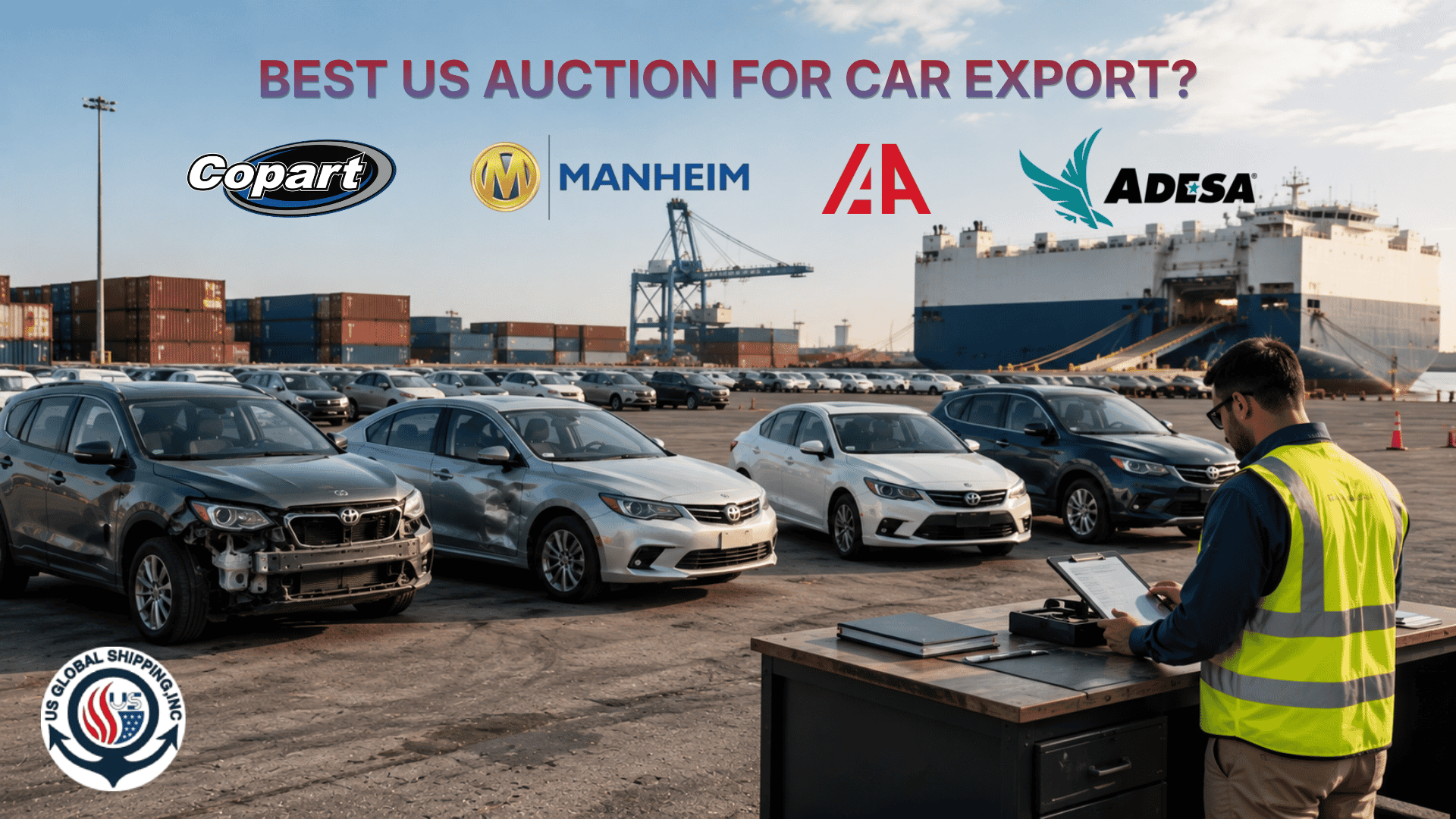
The United States runs four major vehicle auctions that supply most of the inventory international car buyers ship out every year. They look similar from the outside, but the differences in title mix, access rules, and pricing decide whether a shipment makes money or sits at the port. Choosing the right platform is the first real decision in any auction sourcing plan.
When choosing between the four major US auctions, weigh:
- Whether your destination country accepts salvage titles
- The vehicle age limit at your destination port
- Your tolerance for repair work before resale
- Whether you need clean-title or insurance write-off inventory
- Public access rules at each auction
- Broker fees and dealer-only restrictions
- Your shipment volume per year
- The auction location relative to your export port
Copart and IAAI run on insurance write-offs, salvage, and fleet returns. Manheim and ADESA run on dealer wholesale inventory, mostly clean-title off-lease and trade-ins. Most international buyers eventually need access to all four because no single auction covers every type of vehicle a destination market demands.
The right combination of auctions is downstream of the destination country. A buyer shipping to Lagos has different inventory requirements than a buyer shipping to Riyadh, and the auction strategy has to follow. Picking the wrong platform for a destination wastes weeks of effort and thousands of dollars in re-routing fees.
US Global Shipping holds direct buyer accounts at all four auctions and EDGE Pipeline, giving international buyers access to the full US auction system through one USA auction access program.
The Four US Auctions in Brief
Copart
Copart is the most internationally focused of the four. The platform was built to serve global buyers, and roughly 70 percent of its inventory carries a salvage, rebuilt, or branded title. The remaining 30 percent is clean-title fleet returns and dealer trade-ins.
Copart runs daily online auctions across more than 200 US locations. Public buyers can register for a Basic Membership at 200 dollars per year, but most high-value inventory remains restricted to licensed dealers or registered brokers.
IAAI
IAAI specializes in insurance auto auctions, with inventory skewing even more heavily toward total losses than Copart. About 80 percent of IAAI inventory comes from insurance write-offs, with smaller shares from rental fleet damage and finance recoveries.
Public access at IAAI varies state by state. Some states allow public bidding on a portion of inventory while others restrict access entirely. The buyer letter system at the gate is stricter than at Copart, which is why most international buyers route through brokers who handle gate authorization automatically.
Manheim
Manheim is the largest wholesale dealer auction in North America. It moves roughly 7 million vehicles a year through more than 78 physical locations and the Manheim Express digital platform. Inventory is overwhelmingly clean-title: off-lease returns, off-rental fleet, repossessions, and dealer trade-ins.
Manheim does not allow public bidders. Access requires a US dealer license and an active Manheim dealer account in good standing. For international buyers shipping to markets that ban salvage, Manheim is the primary source of inventory.
ADESA
ADESA is the second-largest wholesale dealer auction in North America, now owned by Carvana. It auctions around 3 million units annually across more than 60 US locations. The inventory mix closely mirrors Manheim, with off-lease, off-rental, and dealer wholesale stock dominating.
Like Manheim, ADESA is dealer-only and inaccessible to public buyers. Most international buyers who work with Manheim source from ADESA in parallel to maximize clean-title volume.
Inventory Mix and Title Quality
The split between salvage-heavy and clean-title platforms drives everything else about auction choice. Buyers feeding rebuild markets need volume of damaged inventory. Buyers feeding resale markets in countries that ban salvage need clean-title cars with verifiable service history.
| Auction | Title Mix | Primary Source |
|---|---|---|
| Copart | Roughly 70 percent salvage | Insurance, fleet, charity, dealer trade-ins |
| IAAI | Roughly 80 percent salvage | Insurance, rental fleet damage |
| Manheim | Roughly 95 percent clean-title | Off-lease, off-rental, dealer trade-ins |
| ADESA | Roughly 95 percent clean-title | Off-lease, repossessions, Carvana wholesale |
For shipping to West Africa, Copart and IAAI are the standard sources because Nigerian, Beninese, and Togolese rebuild markets absorb salvage volume efficiently. For Ghana, which has banned salvage imports since 2020, Manheim and ADESA become the primary platforms because clean-title sourcing is mandatory.
Access Rules for International Buyers
The access question is binary: either you can bid yourself or you cannot. Copart and IAAI allow some level of public bidding, though most of the worthwhile inventory sits behind dealer-only walls. Manheim and ADESA close the door to the public entirely.
| Auction | Public Access | Broker Access |
|---|---|---|
| Copart | Limited subset, Basic Membership | Full inventory |
| IAAI | State by state | Full inventory |
| Manheim | None | Full inventory |
| ADESA | None | Full inventory |
Most international buyers route through a registered FMC NVOCC broker that holds dealer credentials at all four platforms. This is the standard path because it unlocks the complete inventory pool without requiring the buyer to maintain a US business entity. Setup typically takes 1 to 2 business days, and the broker handles bidding, title, transport, and export under one operational team.
Fees and Total Cost
Hammer price is only the starting point. Each auction layers fees on top, and those fees vary by auction and by transaction size. Storage fees compound quickly if the vehicle sits at the auction yard past the free window.
| Cost Component | Copart and IAAI | Manheim and ADESA |
|---|---|---|
| Buyer Fee | 50 to 1,200 dollars tiered | 100 to 1,500 dollars tiered |
| Gate or Document Fee | 59 to 89 dollars | 75 to 125 dollars |
| Storage after Sale | Free 3 days, then 20 to 50 dollars per day | Free 3 to 5 days, then 30 to 75 dollars per day |
| Typical Broker Fee | 200 to 400 dollars | 300 to 600 dollars |
Total cost includes inland transport from the auction yard to the export port, ocean freight, destination duties and taxes, and final delivery. For most international auction car buyers, total landed cost runs 1.6 to 2.2 times the auction hammer price.
Matching the Right Auction to Your Destination
Auction choice is downstream of destination policy. Country-by-country salvage import rules determine which platforms a buyer can realistically use, since age limits and title acceptance vary widely across destinations.
| Destination Market | Primary Auction | Secondary Auction |
|---|---|---|
| Nigeria, Benin, Togo | Copart | IAAI |
| Ghana | Manheim | ADESA |
| Poland, Lithuania, Ukraine | Copart | IAAI |
| Germany clean specialty | Manheim | Copart |
| UAE, Jordan, Iraq | Copart | Manheim |
| Saudi Arabia, Kuwait | Manheim | ADESA |
| Honduras, Guatemala | Copart | IAAI or Manheim |
| El Salvador | Manheim | ADESA |
| Dominican Republic | Copart | Manheim |
Buyers feeding rebuild markets in West Africa or Eastern Europe operate primarily on Copart, with IAAI as the secondary inventory pool when the right collision lots appear. Buyers shipping to clean-title-only markets like Ghana or El Salvador work mostly on Manheim and ADESA. Re-export hubs in the UAE and Jordan often source from all four to maintain mixed inventory for the rebuild and resale lanes they serve.
When Each Auction Wins
Copart is the right primary platform when a buyer needs volume and variety in the salvage segment. Polish and Lithuanian rebuilders, Nigerian and Beninese flood-car buyers, Ukrainian rebuilders, and Iraqi repair shops all start at Copart and use IAAI as the secondary source.
IAAI wins when the buyer specifically wants insurance write-offs and newer collision-damaged vehicles. The inventory is more concentrated than at Copart, so specialists repairing late-model Toyotas, Hondas, and Teslas often find lots at IAAI that Copart does not carry.
Manheim wins for late-model, low-mileage, clean-title inventory. Buyers shipping to markets that prohibit salvage need this source, and Manheim is the largest provider in North America. Condition reports are generally more reliable than at salvage-focused platforms.
ADESA wins as the natural complement to Manheim. Many serious international buyers source from both in parallel because dealer demand varies by sale, and ADESA sometimes surfaces inventory at lower buy-in prices than Manheim on the same day.
Why Multi-Auction Sourcing Decisions Fail
Most auction sourcing problems are preventable. The common failures include:
- Sourcing salvage inventory for a destination that bans salvage imports
- Using a broker with access to only one or two of the four auctions
- Underestimating Manheim and ADESA pricing relative to salvage platforms
- Ignoring storage fees that ramp within days of the sale
- Bidding without a destination-specific landed cost estimate
- Working with brokers who lack a verifiable FMC NVOCC license
- Picking the cheapest auction rather than the right inventory match
These failures rarely show up as a single dramatic loss. They compound over a series of transactions, eroding margin until the buyer realizes the wrong sourcing strategy has been quietly bleeding profit for a year.
How US Global Shipping Handles Multi-Auction Sourcing
US Global Shipping operates as an FMC-licensed NVOCC with more than 20 years of experience in international auction car exports. The brand approach is to consolidate sourcing across all four platforms under one operational team.
- Direct buyer accounts at Copart, IAAI, Manheim, ADESA, and EDGE Pipeline
- Auto export services covering bidding, title, transport, and shipping
- Auto dispatch transportation from any US auction yard to any US export port
- Full container load and less than container load shipping options
- RoRo loading where the vehicle and destination both qualify
- Title processing, AES filing, and bill of lading under one team
- Offices in Greensboro, NC and Amman, Jordan
The value of consolidating sourcing across all four auctions is that it eliminates the inventory blind spots that single-auction brokers create. A buyer shipping to Nigeria might still find the right rebuildable Tundra at IAAI on a week when Copart had nothing, and a buyer shipping to Ghana might find a better-priced clean-title Camry at ADESA than at Manheim on the same day.
Final Considerations for International Buyers
The right auction depends on the destination, the inventory class, and the buyer's tolerance for repair work. The wrong auction wastes weeks of effort and thousands of dollars in re-routing fees, which is why auction selection is best treated as a strategic decision rather than an afterthought.
A short checklist before bidding:
- Confirm your destination accepts the title type you plan to buy
- Confirm the vehicle production year falls within the destination age limit
- Confirm right-hand-drive or left-hand-drive matches the destination
- Confirm the broker holds direct accounts at the auctions you need
- Confirm the total landed cost works for your resale margin
To discuss which auctions match your destination and inventory plan, request a free consultation with the US Global Shipping team and review the specific lanes your shipments will run on.
Frequently Asked Questions
Which is better for international buyers, Copart or IAAI?
Copart is generally the stronger starting point because it carries larger total inventory, a more internationally focused platform, and a broader title mix that includes some clean-title vehicles. IAAI is the better choice when the buyer is specifically targeting insurance write-offs and newer collision-damaged total-loss vehicles. Most serious international buyers run accounts at both through their broker rather than choosing one over the other.
Can international buyers buy from Manheim and ADESA?
Yes, but only through a registered broker holding US dealer credentials. Both Manheim and ADESA are dealer-only platforms with no public bidding allowed. International buyers reach this inventory by partnering with an FMC NVOCC freight forwarder that already operates dealer accounts at both auctions, which is the standard route the industry has used for years.
Which auction has the cheapest cars?
Hammer prices are typically lowest at Copart and IAAI because those platforms run on salvage and damaged inventory. Manheim and ADESA hammer prices are higher because the inventory is clean-title. After factoring in rebuild costs, the salvage platforms may or may not still be cheaper depending on how much work the vehicle needs to return to road condition.
Which auction is best for shipping to Nigeria?
Copart is the standard primary platform for Nigeria-bound shipments because Nigeria accepts salvage imports and Copart carries the largest salvage inventory in the United States. IAAI is the typical secondary source for collision-damaged Toyotas and Hondas that Nigerian rebuilders absorb easily. Manheim and ADESA only become relevant when a Nigerian buyer specifically wants clean-title late-model inventory.
Which auction is best for shipping to Ghana?
Manheim and ADESA are the primary platforms for Ghana. Ghana banned salvage-titled vehicle imports in 2020, so Ghanaian buyers must source clean-title inventory exclusively. The volume and condition reports at Manheim and ADESA make them the most reliable platforms for this destination, with Copart's clean-title subset as a smaller secondary source.
How much does it cost to use a broker?
Broker fees typically range from 200 to 600 dollars per vehicle. Copart and IAAI broker fees usually fall in the 200 to 400 dollar range, while Manheim and ADESA broker fees are higher because the dealer account requirements at those platforms are more rigorous. The broker fee replaces the cost and complexity of obtaining a US dealer license, which would otherwise run into the thousands.