
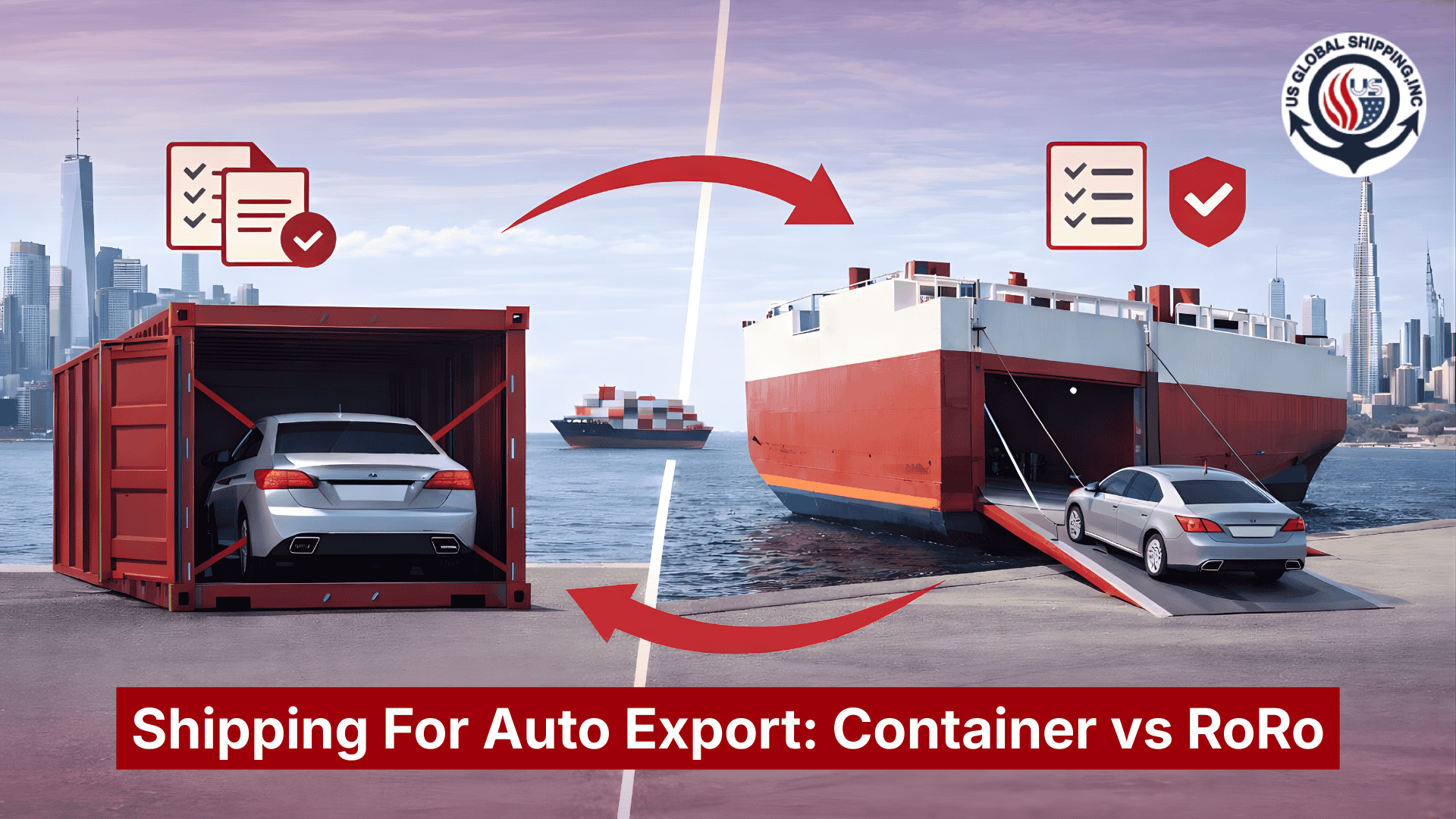
Best Shipping Method for Auto Export from USA to UAE: Container vs RoRo
Exporting a vehicle from the United States to the UAE looks straightforward—until it isn't.
Once you move past quotes and schedules, one question quietly determines how smooth or stressful the export becomes:
Should you ship by container or RoRo?
Most exporters are told this is a cost decision.
In reality, it's a risk and suitability decision and the wrong choice often shows up after the car has already left the U.S.
This guide explains how experienced exporters choose between container shipping and RoRo, and how to avoid the mistakes that cause delays, damage, or unexpected costs when exporting vehicles from the USA to the UAE.
Why shipping method matters in auto exports
Auto exports are different from general cargo.
Vehicles are:
- High-value assets
- Strictly documented
- Inspected at multiple stages
- Subject to destination-country compliance
The shipping method you choose affects:
- How the vehicle is handled
- What condition it arrives in
- How easily it clears UAE customs
- How predictable the overall process feels
A cheaper method is only cheaper if nothing goes wrong.
Understanding RoRo shipping for auto exports
RoRo (Roll-on/Roll-off) shipping means the vehicle is driven directly onto a specialized vessel and secured in a designated car deck.
When RoRo is a strong choice
RoRo works best when the vehicle:
- Is fully running and drivable
- Has no major exterior or structural damage
- Does not require parts or accessories shipped inside
- Meets export and import compliance cleanly
Why exporters choose RoRo
- Cost-effective for standard vehicles
- Faster loading and discharge
- Minimal preparation requirements
- Well-suited for sedans, SUVs, and pickups
Where RoRo becomes risky
RoRo is not ideal when:
- The vehicle cannot start or move
- There is visible damage or missing components
- The export timeline is tight and inflexible
- The exporter is trying to "force fit" the method
RoRo assumes the car behaves like a normal car. When it doesn't, delays and rejections follow.
Understanding container shipping for auto exports
Container shipping involves loading the vehicle into a sealed 20ft or 40ft container, secured and protected for the entire voyage.
When container shipping makes more sense
Containers are often the better choice when:
- The vehicle is non-running
- The car is high-value or rare
- Extra protection is required
- Parts, accessories, or household goods ship with the vehicle
Why exporters choose containers
- Greater protection from handling damage
- Controlled loading environment
- Lower exposure to port-side risk
- Better fit for luxury, classic, or specialty vehicles
The trade-off
- Higher upfront cost
- Slightly longer preparation process
- Requires experienced loading and securing
For many exporters, the container isn't about cost—it's about certainty.
Container vs RoRo: the decision exporters should actually make
Here's the difference experienced exporters understand:
RoRo is efficient when everything is normal. Containers are forgiving when something isn't.
Instead of asking "Which is cheaper?", ask:
- What condition is my vehicle actually in?
- How much risk can I tolerate?
- What happens if the timeline slips?
The best shipping method is the one that absorbs risk, not the one that ignores it.
Why UAE destination standards matter
UAE ports, especially Jebel Ali, are structured, efficient, and strict.
What matters on arrival:
- Vehicle condition matching export documents
- No undocumented damage or loose items
- Clean paperwork alignment
If the shipping method exposes the vehicle to handling or inspection inconsistencies, clearance becomes slower and more stressful.
Choosing the right method at origin often determines how quiet the destination process feels.
A simple decision framework exporters use
While every shipment is different, many experienced exporters follow this logic:
- Running, clean, standard vehicle → RoRo
- Non-running, damaged, high-value, or sensitive → Container
The key is evaluation after purchase, not assumption before booking.
How US Global Shipping approaches this choice
At US Global Shipping, container vs RoRo is never treated as a sales preference.
It's treated as a fit assessment.
That means:
- Reviewing vehicle condition and documentation
- Understanding the exporter's risk tolerance
- Coordinating inland transport, staging, and export sequencing
- Shipping to UAE and other Middle East destinations with predictability
Our role is to help exporters avoid problems they shouldn't have had to face in the first place.
Final answer: Which shipping method is best?
There is no universal winner.
The best shipping method for auto export from the USA to the UAE is the one that:
- Matches the vehicle's true condition
- Aligns with export and import compliance
- Minimizes handling and inspection risk
- Produces predictable outcomes, not surprises
Experienced exporters don't chase the lowest quote. They choose the method that lets them sleep while the car is at sea.
Planning an auto export from the USA to the UAE?
If you're exporting a vehicle whether personal, dealer inventory, or repeat shipments; the smartest move isn't choosing container or RoRo in isolation.
It's starting with the right evaluation.
US Global Shipping helps you choose the shipping method that fits the vehicle, the timeline, and the destination before the process begins.
If you want your next export to be fast, smooth, and predictable, the smartest step is simply starting the conversation early.